

Back to Basics

Back to Basics

Author: Alison Price   –   Published: December 2025

 ❤️ Basic Natal Astrology

This article is part of my Basic Natal Astrology category and brings all the beginner components of interpreting a natal chart together. This includes signs, planets, houses, aspects and more. Alison

Sometimes it’s good to get back-to-basics with astrology and here I mean avoiding going down the complicated roads which are scattered liberally throughout any astrology reading or forecast. Alison

Basics

Distractions

Personally, I always like to try out any new technique or astro hack that I’ve happened upon in the past week. This could be anything from checking a Mars to Saturn cross chart aspect to idly exploring the Part of Marriage for a couple whom I’ve just met.

Sometimes it fun to get into the highfaluting parts of astrology readings and there certainly are many of them, but now and then I like to get back to the basics.

Cornerstones

The astrology basics are the signs, planets, houses and aspects, the backbone of chart reading if you will. These four cornerstone components when fully understood will help you provide a better reading for you family, friends and clients. It’s a bit like going back to school to relearn what you think you know.

We all do it.

You’ve been reading charts for ten years and you think you know it all. But to spend a day or two each month revisiting the basics of chart components will stand you in good stead for the charts you will read later this year.

Back to Basics Podcast Episode

For some quick insights listen to our Back to Basics Starzology Astrology podcast episode where Arwynne and I discuss some ideas on learning more astrology to benefit yourself and your clients.

Signs

Capricorn

You know which sign is your weakest one. You know, the one that you’re not really sure of and can never remember the keywords for. For me that tends to be Capricorn. I’m constantly going back over my notes to understand this sign better.

That Capricorn is quincunx my Leo Sun is part of the equation. I’m constantly having to adjust my ideas on the cardinal earth sign as the years go by.

Pisces

The other sign which is quincunx my Leo is Pisces, but here I do have an advantage.

In my life I am fortunate to know a delightful load of mutable water people. My mother, father, sister and daughter are all Pisces.

I am almost swimming in Pisces energy and have been aware of it in action all my life. No surprise there, only that they do what they do.

It all about the shoes…

Planets

Drawing a Blank

Which planet do you know the least about?

You know, the one that you tend to draw a blank on when caught in conversation with your client.

For me this planet is Neptune, so no surprise there. By its very nature Neptune is elusive and a mystery.

Again, I believe (see what I did there?), I believe that it is because the sign which Neptune rules is the sign of The Fish, and that sign too is quincunx my Leo.

More on Neptune

Neptune understands, dissolves and eludes. The people that Neptune represents are dreamers, ghosts, angels and nomads. Neptune rules Pisces.


Neptune

Aspects

Quincunx

Are we seeing a pattern here?

Does this automatically mean that the aspect which I struggle with the most is the lowly quincunx at a mere 150° and with a tight orb of only 2°?

Perhaps.

Ptolemaic

I am far more confident with the big five Ptolemaic aspects which are the conjunction, opposition, trine, square and sextile. These aspects I know well and can wax lyrical about for hours.

Quintiles

Additionally, I love the five-base aspects, the quintiles and bi-quintiles. These aspects are great and show creativity (which I love) and your natural talents.

Brilliant!

Let’s have them too.

So yes, maybe when I go back-to-basics with the aspects I revisit the quincunx aspect which is five signs apart from my Sun and is the one which brings awkwardness and demands adjustments in my thinking.

Houses

12th House

Most of the houses I’m pretty strong on. I know them very well, but now and then I have to pause and perhaps you’ve already guessed it?

I often refresh my memory around the 12th houseThis is a very quiet house and is not really exciting like the 1st, 10th or 5th houses are. The twelfth house tends to be quiet, subdued, and things in it are done privately or in secret.

As an astrologer, one never really knows how someone will use the energy, or not, found in this house and what goes on behind closed doors.

Traditionally it is the house of self-undoing, of recouperation and convalescing (post-partum) and or being in solitude self-imposed (retreating) or forced upon you (incarceration).

Going Forward

Going Back

When you’ve been doing astrology for over thirty years you do know a lot and you may become complacent in your knowledge in general.

I believe that we can all benefit from some self-reflection and the action of revisiting some cornerstones of astrology to build our own solid foundation of knowledge.

You may have learned your astrology decades ago and if so, it will do you good to enliven your ideas on certain signs, planets, houses or aspects.

Seasonal

You don’t have to be doing this every day or every week for that matter. I like to do some back-to-basic work once each season. The four seasons are winter, spring, summer and autumn. They start at the solstices and equinoxes.

Because we as good astrologers are paying attention to the Sun’s annual ingresses into the four cardinal signs, it can be a great reminder to practice some back-to-basics studying for ourselves.

Extend Yourself

Take a moment to consider in which of the four cornerstones you are weakest in your knowledge.

In your astrology journal note your weakest:

  • Sign
  • Planet
  • House
  • Aspect


Awareness

Don’t feel you have to tackle all of these right now but do yourself a favor and address one weakness this season to improve your astrology knowledge for the future.

You will become a better astrologer for it and your readings for your family, friends and clients will improve as well.

Everyone benefits.

Overarch

Growth or Stagnate

It’s one thing to have twenty years of experience and another to have one year of experience twenty times. In the former you are growing and, in the latter, you are stagnant.

Make sure you develop your astrology knowledge each year through simple seasonal reflection. Actively do some self-imposed revisiting of what you thought you knew.


Author Bio

Alison Price: Professional Astrologer

Alison helps you uncover your individual creativity and lead a fulfilling life using your own astrology. She shares her wisdom from the heart with a touch of humor. She offers Consultations for everyone and Coaching for Aspiring Astrologers.

If you’d like to get in touch with Alison, you can reach out to her via email at starzology@gmail.com.

More Articles

If you enjoyed this post, you may like some more astrology related articles from our blog.


Music

Music

Birth charts of famous musicians, Mozart, Lennon and Swift and a personal music teacher Jim and the importance of Mercury, Venus and Neptune.

Saturn Rituals

Saturn Rituals

Alison and Arwynne discuss the SATURN RITUALS which were gifted to us by our superfan, Bo. They explain how to work with Saturn’s energy as the Sun transits both Capricorn and Sagittarius each year.

Example Chart: Maxie

Example Chart: Maxie

Author: Alison Price   -   Updated: January 2025 Example Chart Reading I have so many requests from my readers for example chart readings and wanting more about how to get going with chart readings, where to start, what to look at first and what's important. There are...

affiliates-green-star

Astrology Basics – Chart Points

Astrology Basics – Chart Points

Chart Points

Points in the Chart

Concentrated

Chart points are not planets and they are not physical bodies. They are sensitive points in space created where important imaginary lines intersect in the birth chart. These points describe angles, directions and areas of life where experience is concentrated and noticeable.

Symbolic

Chart points show how you meet the world how the world meets you and where significant life themes unfold. Even though they have no physical mass they carry great symbolic meaning and are essential for chart interpretation.

The Ascendant

Façade

The Ascendant also called the Rising sign is the face you show to people in one on one situations. It is the mask or façade you present to strangers and new environments. This is the first thing people notice about you before they get to know you more deeply.

Entrance

The Ascendant describes your appearance mannerisms body language and instinctive responses. It shows how you approach life and how you step into new situations. It is your doorway into the world and colors the way your entire chart expresses itself.

Important

Because the Ascendant is tied to the moment of birth it is one of the most personal points in the chart.

Introduction to the Ascendant

Think of the Ascendant as your personal sunrise. Just as the Sun rises on the horizon at the moment you were born the Ascendant marks the beginning of your life experience. It sets the tone for how you initiate action meet challenges and interact with others.

Ascendant Sign

The sign on the Ascendant shows your natural style and approach. The ruling planet of that sign becomes especially important as it describes how you move through life and express your identity.

The Midheaven

Public Face

The Midheaven also known as the MC represents the face you show to the world at large. It describes what you are known for your public image and your role in society. This is the part of you that is visible in your career reputation and long-term achievements.

Life Direction

The Midheaven reflects your ambitions goals and the direction you aim for over time. It can show your vocation life path and the kind of recognition you seek. While the Ascendant is how people first meet you the Midheaven is often how they remember you.

The Descendant

Life Partners

The Descendant sits directly opposite the Ascendant and represents other people particularly close partners. It describes what you seek in relationships and the qualities you tend to project onto others.

Relationships with Others

This point relates to marriage, committed partnerships and one on one connections. The Descendant shows what you need from others to feel balanced and complete and often reveals traits which you develop through relationship experiences.

The Immum Coeli

Private

The Immum Coeli also called the IC is the deepest point in the chart. It represents your private inner world your roots and your sense of home. This point is connected to family ancestry and your emotional foundation.

Hidden

The IC shows where you retreat to feel safe and grounded. It reflects your early environment and what nurtures you at a core level. While the Midheaven is public the IC is deeply personal and hidden from view.

The Vertex

People

The Vertex is a sensitive point usually found on the right-hand side of the chart. It is associated with significant encounters and people who enter or exit your life in meaningful ways.

Turning Points

The Vertex often describes fated meetings turning points and relationships that feel destined. Events linked to the Vertex tend to arrive unexpectedly and can have a lasting impact on your life direction.

The Part of Fortune

The Part of Fortune shows where and how your personal fortune is likley to manifest in this lifetime.


The Lunar Nodes

The two lunar nodes, North and South, show your destiny, past and future.


astrology-chart-points

Pin this to read later

Author Bio

Alison Price: Professional Astrologer

Alison helps you uncover your individual creativity and lead a fulfilling life using your own astrology. She shares her wisdom from the heart with a touch of humor. She offers Consultations for everyone and Coaching for Aspiring Astrologers.

If you’d like to get in touch with Alison, you can reach out to her via email at starzology@gmail.com.

More Articles

If you enjoyed this post, you may like some more astrology related articles from our blog.


Astrology Basics: The Aspects

Astrology Basics: The Aspects


Aspects

A Cornerstone of Chart Reading

This is part of the Starzology Astrology Basics series of posts on the four cornerstones for reading a chart. This is what you need to know to read a chart. The other cornerstones are signs, planets, houses and a fifth cornerstone (?) is  chart points.


Podcast Episode: Aspects Introduction

In this podcast episode, Alison and Arwynne provide valuable insights into the aspects of your birth chart.

They delve into the specific angles of major, minor and lesser used aspects, discuss the orbs that influence them, and offer real-life examples of how these aspects manifest in actual charts.

Additionally, they offer guidance on where to begin and how to determine which aspects hold significance in your natal chart.

Introduction to Aspects

Aspects are the angular correspondences formed between planets, angles and other points in a chart.

They are measured in degrees and minutes of longitude in the signs.

Aspects are a function of simple geometry.

  • Every planet will usually have some aspects.
  • Not all charts will contain all the different aspects.
  • It is unlikely that all planets will have every aspect.
  • Not all planets will aspect each other.
  • Some planets may not receive any aspects from other planets (an unaspected planet).
  • Often charts will have a preponderance of one particular aspect such as trines or squares.

Aspects in General

Aspects and aspect patterns show the main story lines within a chart.

The dialogue between the planets and chart points is found by the planetary connections expressed through the aspects.

Aspects are like a conduit passing information between two planets.

Two planets in aspect will communicate with each other for better or for worse depending on the actual planets and the aspect in question.


Applying and Separating Aspects

An aspect is determined to be either applying or separating.

This state depends on the speed of the two planets and their position in regard to each other.

The planets are listed here by speed, from the fastest moving planet to slowest moving planet; the Moon, Mercury, Venus, the Sun, Mars, Jupiter, Saturn, Chiron, Uranus, Neptune and Pluto.

Note

Note: Sometimes Mercury and Venus can be slower than the Sun it depends on their position at the time.


Applying Aspects

Aspects that are applying are stronger than those separating.

The applying faster planet is moving towards the exact (or partile) aspect with the slower moving planet.

During an applying aspect the pressure is still building, and the effect is of potential still to come.

Aspects are applying when the faster moving planet has yet to catch up to the slower moving planet’s degree position.

Example

The Moon at 10° Virgo is applying a conjunction to the Sun at 15° Virgo.


Separating Aspects

Aspects are separating when the faster moving planet has passed the degree position of the slower moving planet.

After the aspect has been exact the aspect is separating and the effect is more of release or acceptance.

Example

The Moon at 15° Gemini is separating from an opposition to the Sun at 10° Sagittarius.


Pin this image to your Pinterest board.

Major Aspects

We will focus on the major and minor aspects.

The major aspects are the ones used by the Greeks and are today known as “Ptolemaic aspects” after Claudius Ptolemy.

The five major aspects are the conjunction, opposition, trine, square and sextile.

Understanding Aspect Orbs

Orb Definition

An orb is the number of degrees by which an aspect can deviate from being exact while still being considered in effect.

Think of it as a margin of error or a zone of influence around the exact aspect angle.

The Importance of Orbs

Orbs are essential because planetary aspects are rarely exact to the degree.

By using orbs, you can determine:

  • Whether an aspect is in effect.
  • How strong the aspect’s influence is (tightness of orb).
  • Whether an aspect is applying (becoming more exact) or separating (becoming less exact).


Choosing Orbs

Debate

Aspect orbs are debated long and hard by astrologers who get together for an evening social. The debate goes on.

I suggest that if you are starting to learn astrology keep to my standard orbs, and as you become more experienced you can adjust the orbs to wider or tighter as you wish.

It is up to you.

Standard Orbs

These are the standard orbs I use.

  • Conjunction, opposition, trine and square: orb 8°.
  • Sextile: orb 4°.
  • Minor aspects: orb 2°.
  • Lesser used aspects: orb 1°.

Aspects of Longitude

The Good, the Bad and the Ugly

Aspects of longitude are the angular relationships between planets in a birth chart.

Think of them as cosmic conversations or dialogues where some planets are in harmony, others in tension and some are indifferent to each other.

These relationships influence how the energies of different planets interact and manifest in our lives.

The Five Major (Ptolemaic) Aspects

Where to Start

These aspects should be interpreted first in this order; conjunctions (neutral), oppositions and squares (hard) then trines and sextiles (soft).

So any conjunctions come first.

Only if you have time go onto the minor aspects.

The Conjunction

First Harmonic

The circle divided by one. 360°/1 = 360°. 

Usually planets in conjunction will be in the same sign or house. 

When a conjunction occurs over a sign boundary, they are said to be in a disassociate conjunction

For instance, if the Sun is at 29° Virgo and the Moon is at 4° Libra, they are still conjunct but in a disassociate conjunction.

Conjunction (0°)

When two planets are very close together, their energies blend and intensify.

This can be harmonious or challenging, depending on the planets involved.

Conjunction Aspect Meaning

The conjunction is the most powerful aspect. It inclines the two planets towards togetherness and blends their energies. The planets virtually move as one and they have synergy

Synergy means one plus one equals three. Each planet is indistinguishable from the other. 

They show the same face to the world. Because of their close proximity it is hard for the first planet in the conjunction to clearly see the second planet and vice versa.

The Sextile

Sextile (60°)

Sextiles offer opportunities for growth and learning.

They require some effort to activate but bring positive outcomes.

Planets in sextile work well together and support each other. 

They suggest that you have latent talents in the nature of the planets involved and this can be brought forward for the creativity and vision in your life. The sextile is a soft aspect.


The Trine

Trine (120°)

Trines represent harmony and ease and are usually in the same element.

Planets in trine support each other, offering natural talents and opportunities.

Planets in trine to each other are easy going and let the other planet be themselves. This is the best aspect of support and being positive. The trine is an easy or soft aspect.


The Square

Square (90°)

The challenging square creates internal tension and dilemmas.

While difficult, squares drive us to take action, get of the couch and grow.

Planets that are square to each other have some tension between them. Their energies compete for dominance and challenge each other. Planets in square create internal dilemmas for you. The square is a hard or difficult aspect.


The Opposition

Opposition (180°)

Planets facing each other across the chart create a tug-of-war energy where projection is a theme.

Oppositions bring awareness through relationships and balance.

Planets that oppose are in tension with each other and will struggle to work together. 

These planets create external dilemmas for you and can indicate where you project the issues to the other.

 The opposition is a hard or difficult aspect.


[embedyt] https://www.youtube.com/watch?v=gm8ke9UPzU4[/embedyt]

Minor Aspects

The minor aspects are those found to have value in chart interpretation. The four minor aspects are the semi-square, sesquiquadrate, semi-sextile and quincunx. 

Minor Aspect Orbs

The orb for minor aspects is 2° both applying and separating.

Minor Aspects – Twelfth Harmonic

The twelfth harmonic aspects suggest potential frustrations where constant adjustments are required to maintain equilibrium in whatever is brought up by the planetary energies involved in the aspect.

Semi-sextile Aspect

Calculation

The circle divided by twelve. 360°/12 = 30°. The semi-sextile is half a sextile and one twelfth of a circle.

Semi-sextile Aspect Meaning

The semi-sextile suggests subtle niggling tensions.

It creates a slight unease that can motivate learning and adaptation

The semi-sextile is an aspect that can be unsettling and disruptive. There can be annoyances and tensionsIt is a difficult aspect but in a quiet way. Both planets behave as if the other did not exist and try to ignore each other. The semi-sextile shows where you will push something off to another and try to redirect.

Quincunx Aspect

The circle is divided by twelve and then timesed by five. (360°/12) = 30° x 5 = 150° (i.e. 5/12). 

A quincunx was a Roman coin. The origin of the word is from the Latin “quince” meaning five and “uncla” meaning one-twelfth. The quincunx is sometimes referred to as the inconjunct.

Quincunx Aspect Meaning

The quincunx is the aspect of adjustment, paradox, and the need for compromise. Also known as the inconjunct, the quincunx creates a sense of niggling unease that requires constant fine-tuning

It is an aspect of awkwardness and unease. 

The quincunx shows where adjustments are needed. 

These two planets will grind along, but are never happy together. 

They can be un-supportive of each other and make for disharmony in a niggling way.

quincunx-aspect-glyph

Minor Aspects – Eighth Harmonic

These aspects fall into the eighth harmonic which indicates they are manifesting aspects and will generally exacerbate change through tension upon us.

Semi-square

The circle divided by eight. 360°/8 = 45°. The semi-square is also known as the octileOrb for a semi-square is 2°.

Semi-square Aspect Meaning

The semi-square is an aspect of internal tension.

It can create low-level stress that pushes for personal development

The semi-square is half of a square and it can be difficult to work the two planets energies smoothly. 

They can be unstable and require a change of approach each time. 

This aspect inclines the individual to persisting and to keep working at making it better and finding a solution.

Sesquiquadrate Aspect

The circle divided by eight and then multiplied by three. (360°/8) = 45°x 3 = 135°. The orb for a sesquiquadrate is 2°. The sesquiquadrate combines one square and one semi-square. The sesquiquadrate is also known as the tri-octile.

Sesquiquadrate Aspect Meaning

Sesquiquadrates indicate external challenges that require creative solutions.

This aspect often manifests as recurring issues that demand innovative approaches

It is an aspect of tension and difficulty. 

The planets challenge each other, and this person has to redo decisions. 

This aspect spurs the person to find peace.

Lesser Used Aspects

Quintile

Although not one of the big five aspects I use the quintile aspect as well as it is the aspect of creativity. Planets in quintile to each other show your creative expression in line with the meaning of the two planets. The quintile should always be considered when analyzing creative expression and outlets in your life. I also consider the lesser-used aspects in the fifth harmonic like quintiles and bi-quintiles. In fact, I like quintiles a lot for insights into creativity and inspiration. Quintiles are 72° and bi-quintiles are 144° with an orb of 1°However, I personally avoid the septiles, noviles and deciles. I’ll explain.


Septiles

When you divide the chart of 360° by seven, you don’t get a whole number as the result is 51.428°The Bi-septile and tri septile also have non-whole numbers or fractions.

Novile

The Novile is an aspect at 40° with an orb or 1°.

This is very close to the semi-square at 45° (orb 2°) and it seems not worth the bother.

Decile

The decile aspect is 36° with an orb of 1°.

This is very close to the semi-sextile at 30° with an orb of 2°.

This aspect again seems like too much bother.


Author Bio

Alison Price: Astrology Coach

Alison specializes in guiding Aspiring Astrologers. Her aim is to help you uncover your individual creativity and lead a fulfilling life using your own astrology. She shares her wisdom from the heart, often sprinkled with a touch of humor.

To learn more about Alison’s journey, visit this page.

If you’d like to get in touch with Alison, you can reach out to her via email at starzology@gmail.com.

More Articles

If you enjoyed this post, you may like some more astrology related articles from our blog. 

Quincunxes

Quincunxes

In astrology, the quincunx aspect is 150 degrees with an orb of 2 degrees. It is the aspect of adjustment, awkwardness and mild irritation. Signs quincunx each other are five signs apart.

May Overarch

May Overarch

This is the May 2026 Starzology Astrology Overarch for stations, ingresses and lunations of interets to aspiring astrologers.

The 12 Houses

The 12 Houses

The chart basics are four basic building blocks of knowledge. as a student of astrology you need to get a grip on some basic principles and this post is about the houses. The other building blocks  are:


The Meaning of the Houses

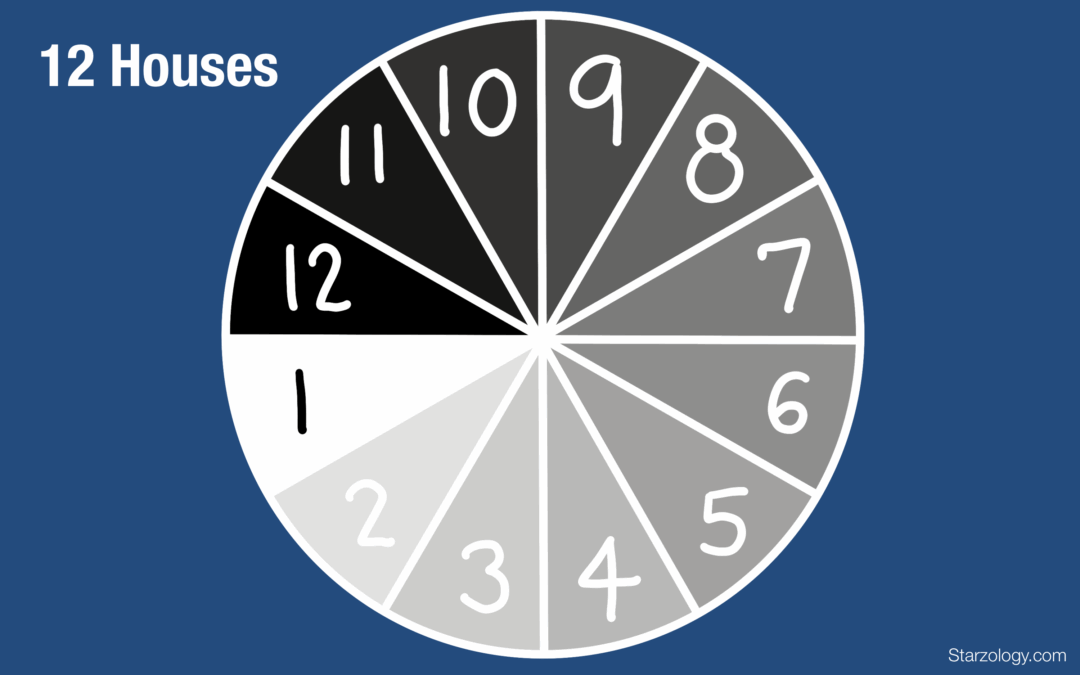
An astrological chart is divided into twelve sections, or houses, and each house is a different size.

The chart looks like a pizza where each house is a segment.

Each house represents a separate area of life and planets in houses suggest that a particular area of life, like family or work, is important to you.

The houses are like a slice of life.


First house

The first house shows you, your body, what you look like, your complexion, fashion style, gait, haircut and first impression.

Second house

The second house is all about money, credit and acquisitions. It shows your values and what you value more than money. It suggests your self-worth and self-esteem.

Third house

The third house shows your brothers and sisters, school, neighbors, local area, short journeys and community involvement.

Fourth house

Your home, hearth and family life is shown by the fourth house in your chart.

Your dominant parent (who is the one was there on a daily basis providing care and nurtured you) is shown by the fourth house.

Fifth house

The fifth is the fun house.

It shows your children, your leisure activities, your romantic dates, play dates, sport, concerts and your creative expression.

It suggests where you find entertainment and this includes risk activities like riding on a roller coaster, playing the stock market and gambling.

Sixth house

The sixth house is the house of your day-to-day work, pets, small plants, health and service to others.

It shows your diet and exercise appetite.

The sixth house in your chart shows your daily rituals, meditation and other habitual practices.

More on the sixth house.

Seventh house

The seventh house indicates your marriage, your partner/spouse, business partners and your relationship with other people.

It shows the general public, your relationship with others and open enemies.

Eighth house

The eighth house suggests your secrets, sex life, money from others, donations from others, support from others, inheritance, insurance, debt, death and taxes.

It shows the inevitable things of life.

Ninth house

The ninth house suggests your vision, life-path, travel, long journeys, higher education, foreign cultures, publications and religion.

Tenth house

The tenth house is all about your career, public standing, reputation and what the world knows you for.

It is where you are in the public eye.

It indicates your passive parent

Eleventh house

The eleventh house shows your choice of friends, groups and causes.

It is where you are a team player.

It shows your social conscious.

Twelfth house

The twelfth house is the house of your imagination, self-undoing, chronic health issues, institutions, dreams, sleep and your subconscious.

It shows your secret enemies.


Starzclass

Aspiring Astrologer Activity: 12 Houses

In your astrology journal, and referring to your natal chart, please do the following:

  • Write a short interpretation on each house. Mention the sign on the cusp, the house ruler, if there is an intercepted sign in the house and any planet in the house (100 words for each house).


Share on social with hashtag #starzclass.

The Astrology of Addiction

The Astrology of Addiction

Author: Alison Price   -   Updated: March 2026 🧡 Advanced Natal Astrology This article is part of my Advanced Natal Astrology series, where I explore deeper chart analysis for practicing and aspiring astrologers. The Astrology of Addiction Introduction...

The Astrology of Addiction

The Astrology of Addiction

Author: Alison Price   -   Updated: March 2026 🧡 Advanced Natal Astrology This article is part of my Advanced Natal Astrology series, where I explore deeper chart analysis for practicing and aspiring astrologers. The Astrology of Addiction Introduction...

Planets

Planets

Author: Alison Price   –   Updated: January 2026

 ❤️ Basic Natal Astrology

This article is part of my Basic Natal Astrology category and brings all the beginner components of interpreting a natal chart together. This includes signs, planets, houses, aspects and more. Alison

Planets

Planets in Your Chart

Planet Selection

There are many planets used in astrology. Each astrologer may choose to use all or only some of the planets in their work.


Visible Planets

Traditional Planets

The seven visible planets are those that can be seen with a naked eye. They are the Sun, The Moon, Mercury, Venus, Mars, Jupiter and Saturn. They are known as the traditional or Hellenistic planets.

Outer Planets

Transpersonal Planets

The three outer planets are Uranus, Neptune and Pluto. They are the modern planets.

Uranus-planet
Neptune
planet-pluto

The Sun

The Sun is your identity, your heart and your character. It shows where you are honest and true to yourself. It is where you can shine in life. It represents your father.

sun-glyph-leo

The Moon

The Moon shows your feelings, reactions, gut instincts and your behavior. It rules food, how you care and who you nurture. It represents your mother, mother figures and caregivers.

moon-glyph

Mercury

Mercury shows your thinking, talking and communication style. It has to do with all buying and selling. It represents your schoolteacher and neighborhood people.

mercury-glyph

More on Mercury

Mercury communicates, trades and is factual. Mercury represents agents, salespeople, youths and teachers. Mercury rules Gemini and Virgo.


Venus

Venus shows beauty, art, style, love and money. It has to do with your values and what you invest in both things like jewelry and people. It represents young women and sisters.

venus-glyphe

More on Venus

Venus is feminine. Venus loves, acquires and appreciates. Venus represents young women, girlfriends, sweethearts and accountants. Venus rules Taurus and Libra.


    Mars

    Mars is about sex, energy, drive, challenges and where you compete in life. It shows when you will get off the couch and do something. It represents young men and brothers.

    mars-glyph

    Mars

    Qualities

    Mars is masculine. Mars competes, challenges and acts. Mars represents young men, boyfriends, bad boys, pioneers, firemen and soldiers. Mars rules Aries and Scorpio.

    More on Mars

      mars

      Jupiter

      Jupiter is about growth, expansion, reaching and even overdoing things. It shows your vision and potential. It represents uncles, teachers and preachers.

      Jupiter-glyph

      Saturn

      Saturn is the planet of achievement, honors, control, limitations and fears. It represents your father, older men and authority figures.

      Saturn-glyph

      Uranus

      Uranus is the planet for the future it rules trends, technology, computers and the space age. It represents adolescents, immigrants, those on the fringes of society and rebels.

      Uranus-glyph

      Uranus

      Qualities

      Uranus changes, breaks and fashions. Uranus represents adolescents, trendsetters, agitators, and immigrants. Uranus rules Aquarius.

      More on Uranus

      Uranus

      Neptune

      Neptune is the planet of illusion, intuition, mysticism, art, magic and the unknown. It represents the psychic, the invisible, the underdog and the homeless.

      Neptune-glyph

      More on Neptune

      Neptune understands, dissolves and eludes. The people that Neptune represents are dreamers, ghosts, angels and nomads. Neptune rules Pisces.


      Neptune

      Pluto

      Pluto is the planet of power, influence and sex. It represents people who have power over you through your use of their resources or those whom you have the drop on. It represents the loan shark, surgeon, psychiatrist, undertaker, criminal and therapist.


      Pluto-glyph

      More on Pluto

      Pluto transforms, buries and rebirths. The people that Pluto represents are crisis workers, the taxman, demons, coercers and the Grim Reaper. Pluto rules the fixed water sign of Scorpio the Scorpion.


      Chiron

      Chiron is the planet of wounds and healing. It suggests where you are weak and wanting. It represents people who help you like nurses, teachers, gurus and charity workers.

      Chiron-glyph

      Eris

      Eris is the planet of the female warrior. It represents the fight instinct in women. It suggests those who will fight for you simply because they are on your team, group or crew. It represents sisters-in-arms.

      dis-planet

      Astrology Basics for Beginner’s

      This is part of the special Starzology Astrology Basics series for you all. Many of you ask where to start and here are the planet’s meanings.

      You can check out the rest of the series: