starzology banner

Astrology Reading

For Everyone

Book a professional one hour online astrology reading and forecast with Alison.

Astrology Coaching

For Aspiring Astrologers

Book a one hour online coaching session with Alison. You choose what you wish to explore.

Starzlife Newsletter

Read about Astrology

Get Alison’s weekly astrology newsletter for creative astro inspiration and promos.

The Moon, Your Mother and Food

The Moon, Your Mother and Food

Author: Alison Price   –   Published: September 2018   –   Revised: July 2024

The Moon, Your Mother and Food

The Moon in astrology serves as a significant indicator of how you experienced your mother and your relationship with food.

Your Moon sign offers insights into how your mother influenced your eating habits and emotional responses related to nourishment.

While a comprehensive analysis of your lunar chart is essential for a detailed understanding, starting with your Moon sign can provide valuable initial insights.


Your Moon Sign and Eating Habits

Your Moon sign represents your instinctive reactions and emotional needs, which are often shaped by early childhood experiences, especially those involving your mother.

The nurturing you received and the habits formed during those formative years play a crucial role in your relationship with food.

When you think back to your childhood, the comfort foods you reach for today are often those associated with early habits and the emotional patterning established by your nurturing environment.

These foods are linked to memories and feelings of comfort and security, which were instilled by your mother or primary caregiver.

Revisiting Childhood Memories

Imagine sitting at the kitchen table as a child.

Try to recall the sounds, smells, and feelings from those moments.

Perhaps you can still hear your mother’s voice, reminding you to eat your vegetables, or the aroma of a favorite dish she used to prepare.

These memories are not just nostalgic; they are integral to understanding your emotional connection to food.

Analyzing the Lunar Complex

While your Moon sign provides an initial understanding, a full analysis of the lunar complex in your natal chart is necessary to uncover deeper insights.

This includes examining aspects, house placement, and other factors that influence how your emotional needs and eating habits were shaped.

By reflecting on these early experiences and exploring your Moon sign, you can gain a better understanding of your current relationship with food and how it ties back to your childhood and your mother’s influence.

This awareness can help you make more conscious choices about your eating habits and emotional responses, leading to a more balanced and nurturing relationship with food.

Moon Signs: A Mother’s Influence on Eating Habits

Moon in Aries Mother

“Eat it while it’s hot,” she commands as she places a sizzling plate in front of you.

Her fiery energy infuses meals with urgency and a sense of immediacy, encouraging you to enjoy the moment and not let anything go to waste.

Moon in Taurus Mother

“Don’t gulp your meal. Take your time and taste the food,” she advises.

Her nurturing revolves around savoring and appreciating each bite, creating a slow and deliberate eating experience that emphasizes quality over quantity.


Moon in Gemini Mother

“Hurry up and finish your dinner, I want the table for our jigsaw puzzle,” she says, drumming her fingers.

Her multi-tasking nature often leads to meals being a quick affair, making way for the next intellectual or social activity.

Moon in Cancer Mother

“I prepared your favorite recipe, so when you eat it, it will make me feel good,” she murmurs, patting your hand.

Her emotional connection to food is strong, and she finds joy in nurturing through homemade comfort meals that evoke feelings of security and love.

Moon in Leo Mother

“I have created yet another culinary masterpiece in my kitchen. I have put my heart into the preparation of your meal. I hope you appreciate it. Eat up,” she declares dramatically.

Her meals are grand expressions of her love, and she seeks recognition and appreciation for her efforts in the kitchen.

Moon in Virgo Mother

“Everything in this meal is healthy, so clean your plate,” she insists, meticulously checking a food values label.

Her attention to detail ensures that meals are nutritious and balanced, promoting a disciplined approach to eating.

Moon in Libra Mother

“I’ll make a deal with you: If you eat your veggies, we can have cake,” she proposes, sitting opposite you.

Her balanced approach to meals often includes negotiations and compromises, creating a harmonious dining experience.

Moon in Scorpio Mother

“Don’t waste food, people in the world are dying of starvation. Eat up,” she says, watching you closely.

Her intensity and awareness of deeper issues translate into a no-nonsense attitude towards meals and a strong emphasis on not wasting food.

Moon in Sagittarius Mother

“I’m trying a new-fangled recipe, what do you think? Oh, please have some more, I made plenty.

In fact, there is enough so I can take what’s left to the big hall meeting later tonight,” she exclaims enthusiastically.

Her adventurous spirit shines through in her culinary experiments and generosity.

Moon in Capricorn Mother

“I’m tired of cooking you the same old meals every day, but tradition is tradition, so eat what I say.

I am your mother (and therefore the food authority),” she states firmly.

Her adherence to tradition and authority makes meals a structured and predictable affair.

Moon in Aquarius Mother

“I have to dash out to my book club, but you can find something to eat, can’t you?

There is cold pizza in the fridge,” she says, standing at the door.

Her unconventional and independent nature often leads to a more laissez-faire approach to meals, encouraging self-sufficiency.

Moon in Pisces Mother

“I have had to sacrifice to provide this meal. If you don’t eat it, I will be upset,” she softly says.

“But, I fed you only yesterday!”

Her empathetic and sometimes sacrificial approach to nurturing can make meals a deeply emotional experience, often tied to her own feelings of sacrifice and care.

moon-mother-food-pin


Pin this to read later


moon-mother-food

Author Bio

Alison Price: Professional Astrologer

Alison helps you uncover your individual creativity and lead a fulfilling life using your own astrology. She shares her wisdom from the heart with a touch of humor. She offers Consultations for everyone and Coaching for Aspiring Astrologers.

If you’d like to get in touch with Alison, you can reach out to her via email at starzology@gmail.com.


More Articles

If you enjoyed this post, you may like some more astrology related articles from our blog.


Back to Basics

Back to Basics

In astrology, getting back to basics can help you with your readings by refocusing on what really matters and leaving the obscure behind, for now…

Color of the Year

Color of the Year

Pantone - the Color People Color of the Year Towards the end of each year, Pantone announces a new color for the forthcoming year. The publication of the Color of the Year is highly anticipated, mainly by artists, graphic designers, trend setters and the New Age...

No Results Found

The page you requested could not be found. Try refining your search, or use the navigation above to locate the post.

Basic Chart Interpretation – Step 4 – Detailed Notes

Basic Chart Interpretation – Step 4 – Detailed Notes

Chart Interpretation: Step 4: Detailed Notes

This post is part of a series on basic chart interpretation and how to read a natal chart. The other steps are listed below and will be developed soon.

Step 1 – The birth chart data – time, date and place.

Step 2 – The physical chart – printing and highlighting main features.

Step 3 – Preparing for the interpretation – margin notes

Step 4 – Your interpretation – detailed notes


Basic Chart Interpretation Step 4 – Your Interpretation – Detailed Notes

The fourth step for a basic chart interpretation is where you take the margin notes and flesh them out.

You can either write directly onto the margin notes page or type some detailed notes up for a written report for your client. I tend to do the written notes if I am having a face to face session with my client.

Gone are the days of written reports but some of you may still find there is a clarity that comes from details written notes. I certainly suggest you do this at least once either for your own chart of someone close to you.

It is a good exercise in the discipline required to read an astrology chart.


Example Detailed Notes

Below is an example of the first page for detailed astrology chart notes for an example chart.

Each piece of the chart is considered and a report like this can be over 50 pages of text.

If you have Solar Fire you can start to add each paragraph into the database so you don’t have t o keep repeating yourself in the future when you do another chart which has the same components.

Notice how the second paragraph draws together the three parts of; the strong western hemisphere, the strong triple division of houses and the strong second quadrant.

This is a typical feature of interpretation where three indicators bring clarity to your readings.

1 Strong western hemisphere

2 Strong 2nd triple division of house

3 Strong 2nd quadrants

You always need to be on the look out for themes and indicators that come from more than one source when doing a basic chart interpretation.


Your Future Chart Interpretations

The more charts you read the better you will get at interpretations.

There is a tipping point for chart readings and when they start to get easier. It is after your twenty-fifth chart that you suddenly can read a chart with ease.

Tips on How to Read a Birth Chart

Tips on How to Read a Birth Chart

Tips on How to Read a Birth Chart

Every time you start to read a chart there are so many things to look at and it can be daunting.

Here I have brought the essence of chart reading down to a few features to consider. These are things you will always look at when you do any chart reading.

If you practice this type of high level chart your interpretation you will get to the heart of your chart reading sooner rather than later.

These tips will sharpen your focus so you don’t go off at a tangent or wander down a chart reading rabbit hole.


1. The Dominant Broad Stroke

The dominant broad stroke refers to the background feel for a chart. This is shown by the quantity of planets and their distribution throughout the chart.

The broad strokes do not consider individual planets.


Planet Count

You count the visible planets only and this will always add up to seven. The seven visible planets are the Sun, the Moon, Mercury, Venus, Mars, Jupiter and Saturn.

The broad strokes that you count are:

  • The two polarities of active and passive.
  • The four elements of fire, earth, air and water.
  • The three modes of cardinal, fixed and mutable.
  • The four hemispheres of north, south, east and west
  • The four quadrants numbered first, second, third and fourth.

In all of this find the highest possible number and focus on interpreting that broad stroke.


2. The Chart Ruler Complex

The chart ruler is the planet that rules the sign on the ascendant. If it is one of the three signs with two rulers (Scorpio, Aquarius or Capricorn) then look at both rulers.

Look closely at this planet and discover it’s message. Understand the chart ruler by sign, house, aspects and position in the chart.


Strong

The chart ruler is strong if it is in its own sign or in exaltation or in other words if it has essential dignity.

It is strong in accidental dignity which is the natural house of its sign. So for example, Mars in the eighth house is strong because Mars rules Scorpio the natural eighth sign.

Notice if it rules the hemisphere, quadrant, division or the house it tenants.

If the chart ruler has only soft aspects it is supported, but if it receives only hard aspects it is afflicted. A combination of both brings a neutral feel.


Position in the Chart

See if the chart ruler dominates the chart by being high in teh chart and most elevated, oriental, the final dispositor or is it in an angular house (first, fourth, seventh or tenth).

These positions add weight to the planets and give it gravitas.


Major Aspect Patterns

See if the chart ruler is well engaged by being part of a major aspect pattern. Check if it dominates the pattern.

This placement adds strength to the chart ruler.


Chart Ruler’s Direction

Check if the chart ruler’s motion is direct, stationary or retrograde.

Being direct adds weight and makes the planet strong but the state of being retrograde detracts from the planet’s potential. Being stationary can add strength depending on how comfortable it is in its sign.


Read more >>> Dispositor Trees


3. The Sun Complex

Understand the Sun in the chart by sign, house, aspects and position in the chart. A well placed Sun will function far better than an afflicted Sun.

The Sun’s Message

Fully explore the message of the Sun in the chart.


Read more >>> What Each Sun Sign Wants at Work

Explore more >>> Your Astrology Questions Answered


4. The Tightest Aspect

To find the tightest aspect you have to consider the aspects between the planets and the orbs.


What to Look For

Look for aspects between the planets and not the points.

The planets to consider when looking for the tightest aspect are; the Sun, the Moon, Mercury, Venus, Mars, Jupiter, Saturn, Uranus, Neptune, Pluto and Chiron.


What to Ignore

Do not consider any points like the Ascendant, the Midheaven, the Lunar Nodes or the Part of Fortune etc.

I also do not consider the asteroids unless you use them in your daily astrology practice. If not then ignore asteroids including Ceres.


Only look for the five Ptolemaic aspects which are the conjunction, sextile, square, trine and opposition.


Tightest orb

Find the aspect with the tightest orb which should be 00°00′.

See which aspect it is and understand the meaning of this aspect.

Consider at the two planets in the aspect and how they will work together in this chart and in this aspect.

Check the house and signs that the tightest aspect lies over and understand what this means.


tips-on-how-to-read-a-birth-chart-diagram


5. The Prominent Major Aspect Pattern

You need the find the most dominant major aspect pattern in the chart.

Some charts may not have a major aspect pattern and if so, then skip this step.

Major aspect patterns in order of importance are:

If there is more than one major aspect pattern of the same type, say you have three T-squares, then find the tightest orbed T-square, the non-disassociate T-square and the one that includes the chart ruler, the Sun or the final dispositor.

Find this major aspect pattern and fully understand the planets involved in it by sign, house and essential dignity.

Use these tips to help you read a chart quickly and easily.


Read more >>> Essential Dignity

Read more >>> Astrology ABCs

Author Bio

Alison Price: Professional Astrologer

Alison helps you uncover your individual creativity and lead a fulfilling life using your own astrology. She shares her wisdom from the heart with a touch of humor. She offers Consultations for everyone and Coaching for Aspiring Astrologers.

If you’d like to get in touch with Alison, you can reach out to her via email at starzology@gmail.com.

More Articles

If you enjoyed this post, you may like some more astrology related articles from our blog.


Music

Music

Birth charts of famous musicians, Mozart, Lennon and Swift and a personal music teacher Jim and the importance of Mercury, Venus and Neptune.

December 2025 Astro Overarch

December 2025 Astro Overarch

Author: Alison Price   -   Published: November 2025 About Starzology Overarches Who Creates the Starzology Monthly Overarches? Each Starzology Monthly Overarch is thoughtfully written by me, Alison Price, a professional astrologer based in beautiful Vancouver, Canada....

Major Aspect Patterns

Major Aspect Patterns

Author: Alison Price   -   Published: October 2025 Major Aspect Patterns Shapes Aspect patterns are shapes formed by combining several aspects together. They are readily seen in the chart by the aspect lines between the planets. Colors If you use the colors suggested...

The 12 Houses

The 12 Houses

The chart basics are four basic building blocks of knowledge. as a student of astrology you need to get a grip on some basic principles and this post is about the houses. The other building blocks  are:


The Meaning of the Houses

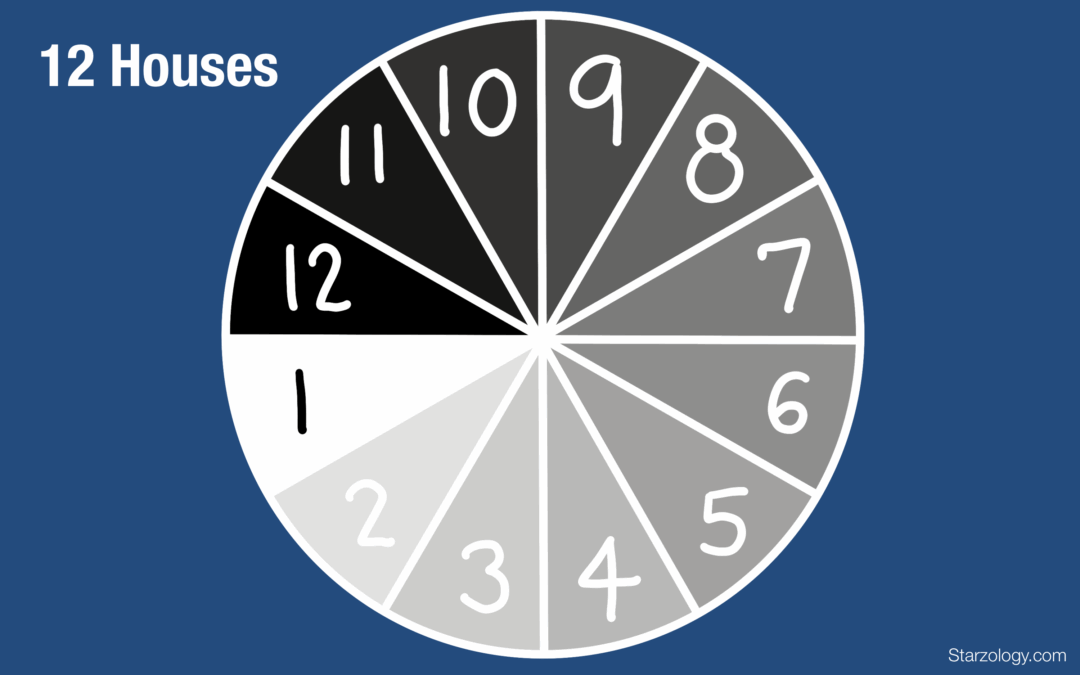
An astrological chart is divided into twelve sections, or houses, and each house is a different size.

The chart looks like a pizza where each house is a segment.

Each house represents a separate area of life and planets in houses suggest that a particular area of life, like family or work, is important to you.

The houses are like a slice of life.


First house

The first house shows you, your body, what you look like, your complexion, fashion style, gait, haircut and first impression.

Second house

The second house is all about money, credit and acquisitions. It shows your values and what you value more than money. It suggests your self-worth and self-esteem.

Third house

The third house shows your brothers and sisters, school, neighbors, local area, short journeys and community involvement.

Fourth house

Your home, hearth and family life is shown by the fourth house in your chart.

Your dominant parent (who is the one was there on a daily basis providing care and nurtured you) is shown by the fourth house.

Fifth house

The fifth is the fun house.

It shows your children, your leisure activities, your romantic dates, play dates, sport, concerts and your creative expression.

It suggests where you find entertainment and this includes risk activities like riding on a roller coaster, playing the stock market and gambling.

Sixth house

The sixth house is the house of your day-to-day work, pets, small plants, health and service to others.

It shows your diet and exercise appetite.

The sixth house in your chart shows your daily rituals, meditation and other habitual practices.

More on the sixth house.

Seventh house

The seventh house indicates your marriage, your partner/spouse, business partners and your relationship with other people.

It shows the general public, your relationship with others and open enemies.

Eighth house

The eighth house suggests your secrets, sex life, money from others, donations from others, support from others, inheritance, insurance, debt, death and taxes.

It shows the inevitable things of life.

Ninth house

The ninth house suggests your vision, life-path, travel, long journeys, higher education, foreign cultures, publications and religion.

Tenth house

The tenth house is all about your career, public standing, reputation and what the world knows you for.

It is where you are in the public eye.

It indicates your passive parent

Eleventh house

The eleventh house shows your choice of friends, groups and causes.

It is where you are a team player.

It shows your social conscious.

Twelfth house

The twelfth house is the house of your imagination, self-undoing, chronic health issues, institutions, dreams, sleep and your subconscious.

It shows your secret enemies.


Starzclass

Aspiring Astrologer Activity: 12 Houses

In your astrology journal, and referring to your natal chart, please do the following:

  • Write a short interpretation on each house. Mention the sign on the cusp, the house ruler, if there is an intercepted sign in the house and any planet in the house (100 words for each house).


Share on social with hashtag #starzclass.

Mercury Square Neptune

Mercury Square Neptune

by Arwynne O'NeillMercury Square Neptune We've talked about Mars and Venus aspects before. This time, we're talking about Mercury, which is the messenger of the gods and the planet that rules speech, thought and communication in all its forms.   Listen...

Mercury Square Neptune

Mercury Square Neptune

by Arwynne O'NeillMercury Square Neptune We've talked about Mars and Venus aspects before. This time, we're talking about Mercury, which is the messenger of the gods and the planet that rules speech, thought and communication in all its forms.   Listen...