
No Results Found
The page you requested could not be found. Try refining your search, or use the navigation above to locate the post.

Author: Alison Price – Updated: January 2026
This article is part of my Your Astrology Business series, where I explore things like when to go professional as an astrologer, business branding pertaining to setting up and running a meaningful astrology business, 25 Tips to polish your readings and what to pack for an astrology conference. Additionally I share stories about how I setup my Starzology Astrology Podcast.
When you think about building your astrology practice, you may focus on marketing plans, pricing or social media.
Yet beneath all of that, something quieter is at work. Your natal chart is already shaping who feels drawn to you.
The outer planets, Uranus, Neptune and Pluto, operate below the surface of everyday awareness.
They describe deep currents in your psyche and the subtle signals you send out without trying.
These energies can influence the type of clients who notice you, resonate with you and eventually reach out for a reading.
The two inferior planets, Mercury and Venus, can be considered in regard to how you operate in general.
Then, by becoming aware of your dominant outer planet, you can begin to work with this natural attraction rather than leaving it to chance.
When you consciously engage your Mercury and bring thoughtful intention to your message, you align your daily actions with your deeper chart signature.
From there, your astrology business starts to feel less forced and more like an authentic expression of who you truly are.
If Venus is your prominent inner planet, the process shifts in a gentle but powerful way. So, rather than leading with analysis and messaging alone (Mercury), you lead with connection.
Venus brings social ease, charm and a natural sense of grace. It softens your approach and makes people feel welcomed, seen and appreciated.
Where Mercury focuses on what you say and how you say it, Venus focuses on how others feel in your presence. Your clients may be drawn to your warmth, your aesthetic, your kindness or the beauty you create around your work.
By working with Venus as your inner guide, you allow your natural social graces to support your outer planet signature, creating a practice that feels both elegant and deeply aligned.

Not all business methods work for all businesses. Not all astrology business’ work the same for everyone either. What gels with for one practitioner will not necessarily pan out for another, because the two astrologers have different natal charts to each other. To find satisfying work, you have to be aligned with the energy potentials shown in your own chart. One way of tapping into this is by looking at your outer planet signature.
Chart signatures are usually assessed by looking at all the planets in the chart. This time we will only look at the outer planets to get an insight into how you work on a more subconscious level.
Usually the planet Uranus, Neptune or Pluto will step forward when you do a quick arithmetic calculation for each planet.
You want to find out what happens when you are not looking and paying attention. Your prominent outer planet will function almost as the background noise, or default mode, of your personal attraction.
You can discover which outer planet is strong in your natal chart by measuring which of them is more energized and engaged in your natal chart by checking with the following table.

If you do the activity to find your dominant outer planet you will have a number which represents the prominence of the outer planet in your chart.
So, what?
Well now you can see the difference in how each of the outer planets operate. Your strong outer planet will work for you over and above the two weaker outer planets in the following manner.
If the outer planet is not strong in the natal chart because say, the Moon dominates the chart, then the outer planetary energy will continue to operate the background of your life.

If Pluto is your dominant outer planet, your client attraction works beneath the surface. You do not always need loud promotion. Instead, there is a quiet intensity about your work that draws the right people toward you. The connection can feel fated, private and deeply personal.
Your words may carry layers of meaning. Subtle or psychologically rich advertising can speak directly to those who are ready for depth. The people who resonate will recognize themselves in what you hint at rather than what you spell out.
At times it can feel as though clients simply show up. There is a sense of inevitability about the connection. They may say they felt compelled to contact you or that something just pulled them in your direction.
Some potential clients watch quietly before making contact. They read your website, follow your posts and observe your tone. They are assessing whether you are safe enough for the kind of deep work they seek.
Pluto work can be intense. Clients may sense that you go straight to the heart of the matter. This can be both attractive and intimidating. They may hesitate, knowing that a reading with you could uncover truths they have kept hidden.
It is common for Pluto signature clients to take their time. They may engage anonymously, subscribe quietly or return again and again before booking. Trust builds slowly, but once established it is strong.
When the timing is right, they step forward. Often this happens during periods of crisis, transformation or deep questioning in their lives. They seek you out because they sense you can handle the raw and complex themes they are facing.

If Neptune is your dominant outer planet, your client flow feels subtle and inspired. You are not always sure how people found you. There is a sense of drift and divine timing. The connection is often emotional, spiritual and based on a shared sensitivity.
Neptune clients respond to mood and imagery. Soft colors, poetic language and creative presentation speak to them. They are drawn to the feeling behind your message as much as the content itself.
Many of your clients may reach out during tender moments. They could be searching for meaning, comfort or reassurance. Some may even say they asked the universe for guidance and then discovered you.
With Neptune, referrals and discoveries can feel mysterious. People seem to absorb your presence over time. They might not recall exactly where they first encountered you, only that they felt guided in your direction.
These clients are captivated by symbolism and the unfolding story of the chart. They enjoy the dreamlike quality of astrology and are willing to explore subtle layers of meaning.
Faith plays a role here. Neptune types often approach astrology with openness and trust. They are ready to receive insight and may already see astrology as part of their spiritual path.
Your Neptune signature attracts seekers. They may meditate, pray or follow a spiritual practice. They value compassion and empathy and appreciate an astrologer who listens gently and holds space with care.

If Uranus is your dominant outer planet, your client attraction can feel electric and unpredictable. People connect with you quickly. There is often an instant spark of shared ideas or excitement about astrology itself.
Uranian clients are fascinated by the craft. They are curious about techniques, systems and new approaches. They may come to you not only for answers but for the love of astrology as a subject in its own right.
Many will want to study. They ask questions about how charts work and how you reach your conclusions. Some may eventually become students, colleagues or collaborators.
These clients appreciate innovation. They are comfortable with technology, online readings and contemporary interpretations. They value fresh thinking and progressive perspectives.
Uranus thrives in communities and networks. You may meet clients through workshops, conferences or astrology groups. Introductions can happen in lively, social settings where ideas are being exchanged.
Online platforms suit your Uranian signature well. Clients may discover you through social media, forums or digital communities. The connection can begin with a comment, a share or a quick message.
Your clients often celebrate their individuality. They enjoy being different and are open to alternative viewpoints. They may seek you out because you support their uniqueness rather than trying to fit them into a mold.
There is often a reforming spirit in your Uranus clients. They are interested in progress, equality and new visions for society. They value astrology as a tool for awareness and awakening, and they look to you for insight that supports their larger ideals.
If Pluto is strong in your chart, your business thrives on depth, trust and transformation. You are not here for light entertainment. You are here to guide people through profound inner change. Your promotion works best when it reflects the seriousness and power of the work you actually do.
Make it clear that you go beneath the surface. Highlight your ability to explore motivations, fears, patterns and shadow material. Clients who are ready for real self examination will recognize the value immediately.
Pluto governs intimacy and taboo subjects. If this is within your skill set, you can signal that you are comfortable discussing sensitive topics. This reassures clients who may feel embarrassed speaking elsewhere.
You do not have to explain everything. A tone of depth and quiet power can be more compelling than over sharing. Let people sense that there is more to discover once they step inside your world.
Exclusivity suits Pluto. Emphasize one to one sessions, confidential containers and focused time. Your ideal clients want to feel held in a secure and undistracted space.
Some Pluto clients prefer discretion. You might offer options that protect identity, such as private bookings or minimal public sharing. This can lower the barrier for those dealing with delicate issues.
Be explicit about confidentiality. State clearly that what is shared in session remains private. Trust is everything in Pluto work and naming it builds confidence.
Use language that reflects transformation. Speak about breakthroughs, healing old wounds and reclaiming personal power. Those in crisis or transition will feel understood.
Pluto resonates with themes of karma, rebirth and the soul journey. If appropriate to your practice, you can include regression style work or karmic chart analysis as part of your offerings.
Times of loss are deeply Plutonian. You can position yourself as someone who gently supports clients through grief, endings and life altering change, helping them find meaning during difficult passages.
When you align your promotion with Pluto’s depth and intensity, you naturally attract those who are ready to do courageous inner work.
If Neptune is strong in your chart, your astrology business grows through compassion, inspiration and subtle connection. You are offering more than information. You are offering reassurance, hope and a sense of meaning. Your promotion works best when it reflects empathy and spiritual awareness.
Let potential clients know that you truly hear them. Simple phrases that convey understanding can be powerful. Many Neptune clients are seeking to feel seen at an emotional or spiritual level.
If you work intuitively, say so. Neptune supports insight that flows rather than follows strict rules. Clients who value this approach will feel comforted knowing you trust your inner guidance.
Highlight your ability to listen. Neptune types often need space to share their story. Emphasize that your sessions are gentle, reflective and non judgmental.
Build bridges through shared feeling. Without oversharing, you can communicate that you appreciate the human experience of confusion, longing and growth. This creates trust.
Neptune clients may fear being dismissed. Affirm that their concerns are valid and meaningful. Your belief in the significance of their struggles helps them open up.
Visual symbols can enhance your message. Soft, mystical imagery or spiritual tools can reinforce the atmosphere of your practice. It is less about theatrics and more about creating a mood of reflection and wonder.
Neptune rules dreams and ideals. Speak about helping clients clarify their life path, reconnect with inspiration and rediscover their purpose. This language resonates deeply.
If this is true for you, allow it to be known gently and honestly. Neptune clients are often spiritually inclined and may actively seek intuitive or mediumistic guidance.
When you promote your work through kindness, imagination and faith, you attract those who are looking for meaning as much as answers.
If Uranus is strong in your chart, your astrology business grows through innovation, independence and fresh ideas. You are here to awaken, to modernize and to connect people through shared vision. Your promotion works best when it feels progressive and future focused.
Position your work as relevant and current. Show how astrology speaks to modern life, technology and social change. Uranian clients want to know that this ancient craft still has cutting edge value.
If that suits you, lean into alternative perspectives. Explore progressive topics, unconventional techniques and emerging schools of thought. Your audience is open to what is different.
Technology is your ally. Online bookings, digital charts and virtual sessions align well with your signature. Even visually, a modern setup reinforces your innovative style.
Uranus carries youthful energy. Emphasize accessibility and openness. Show that astrology is not restricted by age, background or tradition.
Think broad reach. Webinars, group talks and online communities suit your style. You are comfortable sharing knowledge widely rather than keeping it exclusive.
Uranus rules the future and breakthroughs. Highlight forecasting, trends and upcoming shifts. Clients who are excited about what lies ahead will be drawn to you.
You may attract an international audience. Promote cross cultural dialogue and global awareness. Uranus thrives in diverse networks that connect beyond geography.
Align yourself with humanitarian or outreach efforts if that resonates. Uranus values collective progress and social contribution.
Community is key. Whether online or in person, groups, forums and discussion circles amplify your influence. Uranian clients enjoy learning and sharing within a network.
When you align your promotion with Uranus, you naturally attract curious, forward thinking individuals who are eager to explore astrology in a modern and connected way.
Considering your natal chart or the chart of a client:
If you have done chart readings for people or clients already, explain why you think your clients specifically chose you to be their astrologer.

Pin this to read later

Alison helps you uncover your individual creativity and lead a fulfilling life using your own astrology. She shares her wisdom from the heart with a touch of humor. She offers Consultations for everyone and Coaching for Aspiring Astrologers.
If you’d like to get in touch with Alison, you can reach out to her via email at starzology@gmail.com.
If you enjoyed this post, you may like some more astrology related articles from our blog.
The page you requested could not be found. Try refining your search, or use the navigation above to locate the post.

In astrology, your Mercury aspects show how you communicate and interact with others. Also how you barter and buy and sell.

In astrology, there will be a transiting URANUS trine PLUTO aspect which unfolds during 2025-2028. Learn more about this transit.

Author: Alison Price - Published: August 2025 Planetary Aspects I am continuing on with a series on the planet's aspects which is part of a basic natal astrology reading series which I'm working on about the aspects of the planets. Cornerstones Aspects are one of...


Author: Alison Price – Updated: January 2026
This article is part of my Forecasting category and brings all the transits, graphic ephemeris, solar returns, secondary progressions, solar arc directions and other predictive techniques and articles. Alison
Transits and solar returns are direct forecasting techniques.
Secondary progressions and solar arc directions are indirect forecasting methods.
Every day the planets all move. This movement is known as a “transit.” Transits refer to the actual movement of the planets through the zodiac.
Transits are the most popular forecasting technique used by astrologers. Most astrologers will use transits in their work.
All the horoscope columns you read in newspapers and magazines are based on transits.
When a planet transits through the natal houses of a chart it is time for a potential transformation to take place in the area of life relating to that house.
Not all transits will evoke a change in the person, but most will offer opportunities for modification in some way.
Transits do not usually create a visible event but are likely to initiate a psychological shift in outlook, which the person may experience as the beginning of change within.
Since each planet moves at a different speed, some planets will transit all the houses of a natal chart and some only a few in a year.
For example, the Moon will pass through all your houses in one month, whereas Pluto will only be able to transit through less than half of the whole chart during your lifetime.
In transit work we usually only concern ourselves with the outer planets.
Multiple transits to one house in any given year will reinforce any changes and developments being made with the affairs of the house.
As a planet enters a new house it is called an ingress. When a planet changes house it is to be noted, as a shift in approach will be made and a concern for the possibilities evoked by the new house will begin to develop.
An exact birth time is required to correctly calculate transits to your house cusps.

An orb is how close a planet needs to be to the aspect degree to be considered as in aspect.
An example is the conjunction which has an angle of 0°, but two planets are within orb when they get to be less than 1° apart both applying and separating.
The 1° is the orb for a conjunction aspect. For transits initially use a 1° orb for both applying and separating aspects.
When you become more experienced with transits I urge you can reduce the orb to 0°30′. Tightening the orb will provide a more precise forecast period.
It depends on which house is being transited how the planets energy is likely to be experienced.
Planets transiting your 1st house will shape you personally.

Planets transiting your 2nd house will shape your values and finances.

Planets transiting your 3rd house will shape your sibling relationships, local matters, short courses and short travel.

Planets transiting your 4th house will affect your home, family dynamics and your past.

When you have a planet transiting your 5th house you may anticipate changes with your children, creativity and leisure activities.

When a planet transits your 6th house you can expect changes in your work, health, what you do all day and your pets.

When a planet transits your 7th house you can expect changes in your close personal relationship and any business partnerships.

When a planet transits your 8th house you can expect changes in your intimate life, your partner’s resources and the inevitables of life.

When a planet transits your 9th house you can expect some travel, higher education courses and religious views.

When a planet transits your 10th house you can expect career changes, your reputation and sometimes to achieve something good.
When a planet transits your 11th house you can expect to spend time with friends (new or old), acquaintances, groups and clubs and become more aware of social issues.
You may expect an increase in your circle of friends.

When a planet transits your 12th house you can expect a quieter time, solitude and privacy.

When you start with transits begin with the outer planets which are Uranus, Neptune and Pluto.
The outer planets move very slowly and so they exert their influence (or loiter with intent) on a particular degree or degrees of the zodiac for a long time in any given year.
The outer planets move slowly and so can invoke mega changes as they work their way through your chart.
If you have a natal planet at the place where an outer planet will conjoin it the effect will be in orb for a long time.
A conjunction from Pluto may be in orb for twenty-two months, one from Neptune for fourteen months and one from Uranus eight months.
Each situation is different. If the planets retrograde back and forth they will expend their influence that planet has on your chart.
When considering transits from outer planets to the natal chart there are some questions to ask yourself and points to consider.
⠀
As a transiting planet moves through the zodiac signs it will pass through the houses and form aspects to natal planets.
Each chart will be influenced differently from a transiting planet by the placement of the natal planets and points.
For example, transiting Pluto will be in Aquarius for everyone, but it depends where Aquarius is in each chart. This is what creates the unique experience every individual has of a particular transit.
The manifesting aspects are any aspects in the eighth harmonic which are the conjunction, square, opposition, semi-square and sesquiquadrate.
These are the aspects that typically wreak change us through a shift in our situations, attitudes and circumstances.
First, look for conjunctions from transiting planets to the natal planets.
Secondly, look for hard aspects from the transiting planets to the natal planets.
You can then consider the soft aspects, but personally I don’t bother much with these. Initially only consider the transiting Ptolemaic aspects to the natal chart.
A transiting planet making an aspect to a natal planet within, say a T-square, will form aspects, by transit, to all the planets in that T-square, in sequence, depending on the zodiac degree of each T-square planet.
This sequence remains throughout your life.

Albert Einstein has a T-square of Jupiter, Uranus and Pluto.
If we look at the degrees of each planet in the T-square, we see that Jupiter is at 27°29′, Uranus is at 01°17′ and Pluto is at 24°43′.
The sequence is always Pluto, Jupiter, Uranus because of the sign degrees in which each planet is placed.
Every time there is a transit to his T-square the sequence remains the same for life.
Here are some more forecasting articles. I’ll add more as I write them.
Alison helps you uncover your individual creativity and lead a fulfilling life using your own astrology. She shares her wisdom from the heart with a touch of humor. She offers Consultations for everyone and Coaching for Aspiring Astrologers.
If you’d like to get in touch with Alison, you can reach out to her via email at starzology@gmail.com.
If you enjoyed this post, you may like some more astrology related articles from our blog.

Author: Alison Price - Published: May 2026 Secondary Progressions Symbolic Forecasting Symbolic forecasting is different to direct forecasting. It has to do with movement where one day equals one year (secondary) or one day equals one month (tertiary) another...

This article explains one way to assess the influence which Saturn has in a chart, and therefore how strong or weak it is, through the calculation of essential dignity.

Here is theStarzology Astrology April 2026 astrological lookahead where each astrology event is highlighted.

Author: Alison Price - Updated: January 2026 💚 Relationships, Love and Romance Astrology This article is part of my Relationships, Love and Romance series, where I explore compatability, the Part of Marriage, synastry, composite midpoints charts, Davison...

Author: Alison Price – Published: December 2025
This article is part of my Basic Natal Astrology series, where I explore deeper chart analysis for practicing and aspiring astrologers.
Understanding sign rulerships is a foundational step in natal astrology. Every zodiac sign has a planet (or luminary) that governs its expression. This ancient system forms the backbone of chart interpretation and helps explain why each sign behaves the way it does. In this article, I’m going to explore the twelve signs and ten planets. I’ll tell you how the individual sign rulerships of planets came to be, and also which planet rules each sign today. Alison
When I started learning astrology way back, I could never see the rhyme or reason why each sign had a different ruling planet.
It started with Aries and Mars so I couldn’t bring the two together. So back then I just learned them by rote, so I knew which planets ruled which sign.
It was only about two years into my astrology learning that I finally discovered the ancient logic behind why Mars rules Aries, and Scorpio for that matter, and suddenly it all made sense.
So, by you reading this you are getting ahead of the pack with some more astrological insights that will give you something to think about during the next week.
I always say I like to do the type of astrology that keeps the astro conversation going and this article will definitely slot into that.
The zodiac is divided into twelve 30° sections known as the signs. Each sign carries a unique energetic signature. In a broad stroke, the signs describe how planetary energy is expressed.
Aries is assertive bold and ready to take the first step when others hesitate. This sign thrives on momentum and teaches us how to begin with courage.
Taurus is steady sensual and deeply grounded. With Taurus we learn patience loyalty and the value of creating something that lasts.
Gemini is curious communicative and quick on its feet. This sign brings mental agility and reminds us to stay open to new ideas and conversations.
Cancer is nurturing protective and intuitive. It understands emotional safety and shows us how to care for ourselves and others with sincerity.
Leo is creative confident and radiant. It shines through self-expression and inspires us to celebrate our talents with warmth and generosity.
Virgo is analytical practical and meticulous. With Virgo we refine improve and bring thoughtful order to our daily lives.
Libra is harmonious aesthetic and relational. This sign seeks balance and teaches us the art of connection and cooperation.
Scorpio is intense transformative and magnetic. It moves through life with depth and reveals the power of honesty inner strength and emotional rebirth.
Sagittarius is expansive adventurous and philosophical. It explores new horizons and encourages us to seek meaning wisdom and freedom.
Capricorn is disciplined ambitious and structured. This sign builds carefully and shows us how steady effort leads to long term success.
Aquarius is innovative humanitarian and unconventional. It brings fresh ideas and reminds us of the importance of community and progressive thinking.
Pisces is mystical compassionate and imaginative. It moves through life with sensitivity and invites us to dream feel and trust our inner world.
Each sign’s qualities come from the planet that rules it and its planetary ruler is the lens through which the sign expresses itself.
In traditional astrology, we use the 10 planetary bodies (including the Sun and Moon, known as the luminaries).
Each planet represents or governs a different part of human experience.
The Sun represents your identity, vitality and purpose.
The Moon represents your emotions, instinct and needs.
Mercury represents your thinking, speaking and learning.
Venus represents your love, beauty and harmony.
Mars represents your drive, desire and action.
Jupiter represents your growth, luck and wisdom.
Saturn represents your structure, responsibility and maturation.
Uranus represents your innovation, rebellion and awakening.
Neptune represents your dreams, spirituality and dissolution.
Pluto represents your power, regeneration and depth.
These planets act as agents in the chart. Where they fall shows what part of life is activated; the sign they occupy describes how their energy plays out.
The idea of sign rulership comes from the classical astrologers of the ancient world. In the traditional system, rulerships were assigned based on planetary position from the Earth and Sun.
Before the discovery of recent planets which are Uranus, Neptune and Pluto, the old astrologers assigned the five planets plus the Sun and Moon (the visible planets) to the twelve signs.
They arranged the luminaries in the center, assigning:
From there, and specifically from the sensitive cusp between Cancer and Leo, (known as the origin point) the five remaining planets were given rulership of the signs outward in order of their distance from the Sun.
Note that each planet gets a passive and an active sign and each planet is aligned with a particular aspect:
Mercury was given Gemini an air sign and Virgo an earth sign. Both of Mercury’s signs are semi-sextile the origin point. Thus, the semi-sextile is the aspect of Mercury.
Venus was given to Taurus her earth sign and Libra her air sign and both signs are sextile the origin point. Thus, the easy going little good aspect, the sextile, is the aspect of Venus the lesser benefic.
Mars was allocated to Aries his fire sign and to Scorpio his water sign and both signs are square the origin point. Thus, thesquare the little difficult (hard) aspect is the aspect of Mars the lesser malefic.
Jupiter was given to Sagittarius a fire sign and Pisces a water sign and both signs are trine the origin point. Thus, the trine, the big good (soft) aspect, is the aspect related to Jupiter the greater benefic.
Saturn was given to Capricorn his earth sign and Aquarius his air sign and both signs are opposite the origin point. Technically the quincunx as well but the opposition dominates. Thus, the opposition, the big difficult (hard) aspect, is the aspect of Saturn the greater malefic.
This created a perfect, symmetrical rulership pattern for all of the know planets at the time.
Watch this video on How the Signs got their Ruling Planets which I created a few years ago for more information.
When the outer planets were discovered, less than three hundred years ago, modern astrologers at the time assigned these new planets to signs whose qualities they felt they matched.
Uranus to Aquarius as it is radical and progressive.
Neptune to Pisces as it is mystical and boundless.
Pluto to Scorpio as it is deep and transformative.
These modern rulerships exist right alongside the traditional ones. Many astrologers, including myself, use both the traditional and the modern rulerships in their practice.

Here is a clear, I hope, list of both traditional and modern rulerships:
Traditional ruler: Mars
Fiery, assertive Aries channels Mars’ raw drive.
Traditional ruler: Venus
Taurus expresses Venus through pleasure, beauty, and stability.
Traditional ruler: Mercury
Quick-thinking Gemini embodies Mercury’s communication.
Traditional ruler: The Moon
Cancer’s emotional depth mirrors lunar sensitivity.
Traditional ruler: The Sun
Leo shines with solar creativity and confidence.
Traditional ruler: Mercury
Virgo channels Mercury through analysis and refinement.
Traditional ruler: Venus
Libran diplomacy and aesthetics reflect Venusian harmony.
Traditional ruler: Mars
Modern ruler: Pluto
Scorpio’s intensity comes from Mars’ passion and Pluto’s transformative power.
Traditional ruler: Jupiter
Jupiter brings Sagittarius adventure, optimism and wisdom.
Traditional ruler: Saturn
Capricorn reflects Saturn’s discipline and ambition.
Traditional ruler: Saturn
Modern ruler: Uranus
Aquarius blends Saturn’s structure with Uranus’ innovation.
Traditional ruler: Jupiter
Modern ruler: Neptune
Piscean compassion mixes Jupiter’s vision with Neptune’s imagination.
Sign rulerships help you as an astrologer to connect the dots between the planets and the zodiac signs.
Once you understand which planet rules which sign, and the reasoning behind those pairings of sign and planet, you will be able to interpret birth charts with more depth and nuance.
Sign rulers as a component of Basic Natal Astrology is rather essential for beginners, and it’s a cornerstone of all your future astrological study.
Alison helps you uncover your individual creativity and lead a fulfilling life using your own astrology. She shares her wisdom from the heart with a touch of humor. She offers Consultations for everyone and Coaching for Aspiring Astrologers.
If you’d like to get in touch with Alison, you can reach out to her via email at starzology@gmail.com.
If you enjoyed this post, you may like some more astrology related articles from our blog.

In astrology, moiety aspects refine planetary relationships by considering each planet’s individual orb. Discover how one planet may influence another, even when the aspect is not fully mutual.

As an astrologer, knowing how to interpret a Venus retrograde cycle is a great skill both for you and your clients.

Start here for basic birth chart readings and how to interpret a chart. I offer you links to the relevant articles in the premium collection.

Author: Alison Price – Published: October 2025
Have you ever wondered why some people seem to process life in such a distinct way through thinking, feeling and expressing themselves almost in a rhythm of their own? The rising order of the Sun, Mercury and Venus offers a fascinating clue.
Finnish astrologer Raimo A. Nikula explored how the sequence of these inner planets shapes our ego, our communication style, and the way we connect with others.
In this article, we’ll explore the six possible sequences, uncover what each one reveals about perception, thought and relationships, and see how this insight can bring a fresh perspective to your own chart or the charts of those with whom you work. Alison
This article is part of my Advanced Natal Astrology series, where I explore deeper chart analysis for practicing and aspiring astrologers.
Finnish astrologer Raimo A. Nikula has contributed important research on the rising order of the Sun, Mercury and Venus.
His article “The Rising Orders of the Sun and Inner Planets: Introduction to the Pattern of Ego Processing” (Nikula, Volume 52, Number 4, July/August 2010) explores how the sequence in which these three bodies rise can shape personality expression and ego development.
Nikula outlines six possible rising sequences for the Sun, Mercury, and Venus. His focus is on cases where these planets rise consecutively, without being interrupted by the other planets in the chart. In such instances, their order of appearance reveals much about how the individual processes life experience.

The only possible six sequences for rising orders of the inner planets are as follows:
Listen to our recent podcast episode about the rising order of the inner planets which are the Sun, Mercury and Venus.

Represents original perception and how the individual initially encounters the world.
Builds upon and solidifies those first impressions, giving them form and structure.
Indicates the area that requires ongoing nourishment and attention in order to be fully integrated into the personality.
This sequence highlights how the Sun, Mercury and Venus work together in shaping one’s style of ego processing. It shows not only the order in which these planets rise but also the rhythm through which perception, understanding, and integration unfold in a person’s life.
Nikula studied how the rising sequence of the Sun, Mercury and Venus can illuminate the way we process life experiences, form impressions and integrate our ego. When these three planets rise consecutively and without interruption from other planets, their order can be seen as a kind of “ego processing pattern.” There are six possible sequences and each one has a distinct characteristic
Original self-expression is confident and visible. The person projects their identity naturally.
Thoughts and communication solidify the first impression. The individual thinks through their self-expression clearly.
Relationships and values require attention and integration. Social and emotional connections are developed gradually.
Example: Someone with this sequence might appear self-assured and articulate but slowly learns to harmonize with others emotionally.
Below is a copy of Maxie’s chart whom we did an interpretation for earlier this year.
You can see the full interpretations here.
Maxie has her rising order as Sun – Mercury – Venus with no interference from other planets.

Core self-expression is strong and central.te
Social grace, charm, and aesthetic awareness reinforce their identity.
Communication and intellectual integration take longer to fully develop.
Example: This person may be socially engaging and likable, yet may take time to articulate thoughts or make decisions verbally.
Below is a copy of Liza Minelli’s chart.
She has her rising order as Sun – Venus – Mercury with no interference from other planets.

Initial perception is analytical, curious, and mentally alert.
Self-awareness grows, giving clarity and confidence to ideas and personal identity.
Emotional and relational integration develops gradually.
Example: Quick-thinking individuals who gain self-confidence over time but need to nurture relationships carefully.
Below is a copy of Super Jupey’s chart whom we did an interpretation for earlier this year. You can you can see the full interpretation of Super Jupey’s chart here.
Super Jupey has her rising order as Mercury – Sun – Venus with no interference from other planets.

Mental activity and communication dominate initial impression.
Social skills, harmony, and aesthetic sense solidify early perceptions.
Ego expression and personal authority need further nurturing.
Example: Highly social and charming people who may initially undervalue their own identity until later in life.
Below is a copy of Wassily Kandinsky’s chart whom I referenced in this article on Artist’s charts and Venus and Neptunewhich I did earlier this year.
Kandinsky has his rising order as Mercury – Venus – Sun with no interference from other planets.

Approachability, charm, and relational awareness are immediately evident.
Self-expression and core identity strengthen early impressions.
Intellectual integration and communication skills require ongoing development.
Example: Warm and likable individuals whose confidence and voice develop after establishing social connections.
Below is a copy of Julian Assange’s chart. Assange has his rising order as Venus – Sun – Mercury with no interference from other planets.

Social grace and relational awareness are primary.
Thoughts and communication refine the initial impressions.
Self-expression, personal authority, and ego integration take the most time to mature.
Example: People who are outwardly charming and articulate but spend more of life discovering their true identity and confidence.
Below is a copy of Sam Altman’s chart the face of ChatGPT. We spoke about ChatGPT in this podcast episode.
Altman has his rising order as Venus – Mercury – Sun with no interference from other planets.

The first planet indicates initial perception and instinctive approach to life.
The second planet solidifies and supports those first impressions.
The third planet reflects areas that need attention and ongoing “feeding” to integrate fully into the personality.
I like that this simple check of the inners rising order can provide you as the astrologer, so much information right at the start. It seems to me to be an easy way to get a grip on the inner workings of yourself or the person in question.
To understand this simple rising order offers a deeper lens into how your clients process experience, interact socially and develop their ego over time. It also helps us to see the rhythm between intellect, relationships and self-expression in your client’s chart.
By exploring the rising order of the Sun, Mercury and Venus, it gives you such a fascinating window into how you can process life, form impressions and grow your sense of self.
To look at which planet rises first, second and third, you can see the natural rhythm of perception, communication and emotional integration in someone’s chart.
This technique is a reminder to us all that personality unfolds in layers and each planetary rising sequence offers a unique path to understanding and self-expression.
If you read your own chart or someone else’s chart, if you pay attention to this rising order can bring you a deeper insight into how thoughts, feelings and identity come together over time.
Alison helps you uncover your individual creativity and lead a fulfilling life using your own astrology. She shares her wisdom from the heart with a touch of humor. She offers Consultations for everyone and Coaching for Aspiring Astrologers.
If you’d like to get in touch with Alison, you can reach out to her via email at starzology@gmail.com.
If you enjoyed this post, you may like some more astrology related articles from our blog.
In astrology, moiety aspects refine planetary relationships by considering each planet’s individual orb. Discover how one planet may influence another, even when the aspect is not fully mutual.
As an astrologer, knowing how to interpret a Venus retrograde cycle is a great skill both for you and your clients.
The page you requested could not be found. Try refining your search, or use the navigation above to locate the post.

Author: Alison Price – Published: September 2025
This time I’m chatting about one of astrology’s most intriguing forecasting tools, solar arc directions. Once you get your head around them, solar arc directions are simple to use, accurate and can add real depth to your astrology forecasting practice.
Personally, I find that solar arc directions really come alive when combined with transits. The blend offers a fuller and more nuanced picture of what is unfolding in someone’s life.
That said, I want to be clear and that when I’m working with clients, I never rely on just one technique. I weave together a variety of forecasting tools including transits, lunations and eclipses, the graphic ephemeris, solar arc directions, secondary progressions, and solar return charts. Each one adds a different layer, and together they create a richer interpretation and insight on more levels. And just to get an idea, the diagram below shows how I segment my time when forecasting.

In this article, we’re going to focus on solar arc directions, exploring how they work, why they matter, and how you can use them to pinpoint key turning points and life shifts.
Listen to our recent podcast episode about solar arc directions.

Solar arc directions are one of the two main symbolic forecasting techniques in astrology the other being secondary progressions. They are called symbolic because they do not represent an actual astronomical motion of the planets, like a transit does. Rather they give a symbolic measurement of time applied to a natal chart.
The solar arc directions technique, or directions for short, is closely related to secondary progressions. Both techniques use symbolic time measures to move the natal chart forward and reflect the unfolding of your life events.
The key difference is that in solar arc directions, all the planets and chart points are advanced at the same rate as the Sun’s annual motion (about one degree per year). This makes the technique simple, easy to eyeball, consistent and easy to apply across an entire chart.
Solar arc directions can be used on their own as a stand-alone predictive method but not usually. However, I find them most effective when combined with transits. Transits describe the current positions of the planets in real time, while solar arc directions show symbolic growth and inner development. Together, they provide both an inner timeline and an outer trigger, creating a fuller picture of potential life events.
This layering of solar arc directions for psychological themes and growth, transits for outer events allows astrologers to offer rich, multi-dimensional forecasts. For example, a solar arc direction may suggest a significant internal shift, and a transit to the same planet or point might correspond with the actual external circumstances that bring that shift into shart focus.
Astrological forecasting techniques have evolved steadily over centuries, with different astrologers refining and adapting the practice of directions. Solar arc directions, as we know them today, did not appear fully formed instead they grew out of a long tradition of experimenting with symbolic time measures.
Below is a timeline of key contributions:
Claudius Ptolemy outlined the earliest known system of symbolic directions in his Tetrabiblos. Primary directions move the planets and points of a birth chart forward in time at the same rate the Earth rotates (roughly one degree per year of life). This became the foundation for later timing techniques.
Maginus expanded on earlier methods and popularized what became known as secondary progressions, where each day after birth is taken to represent one year of life. This method gave us astrologers a new symbolic way to examine life unfolding.
Naibod introduced a refinement known as the “Naibod arc” which is based on the average daily motion of the Sun (59’08” per day). His approach adjusted the primary direction system, offering a more practical way of timing events.
Placidus brought the system closer to what we now call solar arc directions. His work symbolically advanced all points in the chart by the same arc as the Sun’s movement, creating a unified and simplified technique. This laid the groundwork for modern solar arc forecasting, where every planet and point is moved forward at the solar rate which is about one degree per year give or take. Solar arc directions are now widely used in modern astrology for their simplicity and reliability in predictive work.
The solar arc directed chart is based on the secondary progression method of day-for-a-year.
A solar arc directed chart is calculated by taking the position of the day-for-a-year transiting Sun and moving all the planets and points the exact distance (in degrees and minutes) forwards as the Sun. All the directed planets move forward the same distance as the solar arc directed Sun.
The transiting Sun travels through 360° each year, but it does not move at the same rate each day. The speed depends on the zodiac sign the Sun is transiting. This can affect the solar arc direction calculations.
Here are some approximate values that the directed Sun will move over the course of your liufe.
An arc is part of the curve of a circle.
The degree amount between any two planets in your natal chart is known as an opening.
Each year you will have a wider opening solar arc. At some point, your solar arc distance will equal these planetary openings from smaller to larger openings.
For example, if you have a gap of 25° between your Moon and Jupiter, the meaning of these two planets will be triggered when your solar arc distance equals the opening between your Moon and Jupiter of 25°, which will be at age twenty-five. These planetary openings will be important years in line with the urges of the two planets involved.
It is useful to list all your openings, planet pairs and degrees ahead of time. Not everyone has the same gaps in their natal chart nor has the same pairs of planets at the edges of the gaps.

During the course of the year the Sun moves slightly quicker through Capricorn each day, and slightly slower through Cancer. The distance travelled by the Sun in fifty years may be slightly more, or less, than fifty degrees on the zodiac. It depends on your Sun’s sign at birth if it is initially moving slowly or fast.
The older you are, the longer your solar arc will be. If you are twenty-five years old your solar arc will be around 25°. If you are seventy your solar arc will be around 70°.
There are no retrograde movement in solar arcs as all the planets and points move forward through the zodiac.

If we use the yardstick of one day per year of life, then someone aged fifty years old will have their chart moved 50° forward through solar arc movement. Just by looking at the natal chart you can make a judgement surrounding possible events through the simple movement of solar arcs.
Any planet 15° above the Ascendant, in the natal twelfth house, will reach the natal Ascendant, by solar arc, in fifteen years. This will ignite the person’s personality, self and ego.
Any planet 21° to the right of the Midheaven, and therefore in the natal ninth house, will conjoin the natal Midheaven at around age twenty-one years by solar arc. This will stimulate the urge for status, career and reputation building.
It follows that life-changing events can be closely timed to a solar arc planet conjoining one of the four angles. The conjoining planet will affect yourself (Ascendant), your marriage or life partner (Descendant), your career and public standing (Midheaven) or your family and home life (IC). If you know of specific years when something occurred in line with the meaning of an angle then you can adjust the natal ascendant to suit. In this way using solar arc direction to help find a correct birth time is invaluable.

The directed Midheaven is calculated as per the planets, but the directed Ascendant is calculated in another way. With the directed Midheaven degree, simply refer to the Table of Houses for the natal place of birth to find the directed Ascendant.
There are some unique features of solar arc directions:
Solar arc directions are interpreted by comparing the solar arc directed chart to the natal chart. Typically, you will cast a bi-wheel with the natal chart in the middle and the solar arc directed chart on the outside.
Interpret in the following sequence:
What to note with the solar arc directed chart’s angles:
In a year when a directed angle axis changes house it will be a focus on the affairs of those houses. You will become more oriented to the areas of life suggested by the house and there will be a spotlight on the natal ruler of that house.
This occurs at around age thirty depending on the size of the natal first house.
This occurs at around age sixty depending on the size of the first and second houses.
This occurs at around age of ninety depending on the size of the first quadrant.
This occurs at about age thirty depending on the size of the tenth house.
This occurs at around age sixty depending on the sizes of the previous houses.
This occurs at about age ninety depending on the size of the fourth quadrant.
Referring to your natal chart:
For your next forthcoming Ascendant sign change (above) please do the following:
Alison helps you uncover your individual creativity and lead a fulfilling life using your own astrology. She shares her wisdom from the heart with a touch of humor. She offers Consultations for everyone and Coaching for Aspiring Astrologers.
If you’d like to get in touch with Alison, you can reach out to her via email at starzology@gmail.com.
If you enjoyed this post, you may like some more astrology related articles from our blog.
The page you requested could not be found. Try refining your search, or use the navigation above to locate the post.

Author: Gil Pereira- Published: May 2026 How the Tzolk'in, Haab' and Long Count Work Together A companion piece to Alison's Mayan Long Count Calendar article. If you have already read Alison's piece on the Mayan Long Count Calendar, you know how the Maya measured...

Most people get into astrology by some form of side-stepping or as often is the case you stumble upon it one bright morn.

Author: Alison Price – Published: July 2025
We astrologers love a good pattern. The cycles of the planets:
The patterns are pretty stable and we can count in them.
The golden ratio or the Fibonacci pattern is created by the numbers being added to for the next number in a sequence.
1, 1, 2, 3, 5, 8, 13, 21…
The Fibonacci pattern in nature is found in many animal and plant species.
Sunflower heads have the distinct pattern of how the seeds are laid out so they spiral out from the center. It appears that this is the best way to cram as many seeds into a circle (the head of the flower) as possible and it is thought that this is why nature does it.
In pineapples their eye seeds spiral up in 13 rows one way and 21 rows the other. One spiral being clockwise and the other spiral anticlockwise, but both are Fibonacci.
Found in the nautilus shell. The nautilus is a mollusk that lives in the ocean. It grows like many shells in a whirl ever expanding. The chambers of the nautilus are bigger each time. Fibonacci spirals can be found in other shells as well. The point is that the Fibonacci sequence contains the numbers 5 and 8 and these are specifically related to Venus.
The planet Venus describes a pattern that looks like a flower by its retrograde cycle. This pattern is known as the Venus rose. There are five petals in the Venus rose and this is why Venus specifically rules all 5-petaled flowers.

When you calculate your Solar Return chart, you do it for every year on or near your birthday. The Sun in a solar return chart is always in the exact position as in your natal chart for every Solar return. It is the exact position that makes the Solar Return chart, but the other planets can be in other positions. Now we are going to look at the Venus position in your Solar Return charts. In the subsequent years Venus will be in a different position in each chart.
Every year after you are born Venus will be in a different position. When you get to age 8, your eighth birthday, Venus is very near your natal Venus position (within one degree). Eight years later, Venus is still within one degree of the previous eight-year position. In fact, from your natal chart, if you calculate your solar return for every 8 years, so at age 8, 16, 24, 32, 40 etc. Venus will infinitesimally move from its natal position and painstakingly slowly creep through the zodiac.
This occurs for every group of eight years. For example, the years you turn 5, 13, 21, 29, 37, 45 etc. will have Venus at a different position to the natal, but a similar position for this set (your 5th cycle) of 8-year cycles.
There are only eight starting positions that Venus can be in your Solar return chart. Every eight years the pattern repeats. The Venus position is not as exact as the Solar return Sun is, but it is within one degree from eight years ago of direct. Venus’ solar return position slowly slips over the course of your life. This means that there are eight distinct positions which you can monitor.
Venus can only be up to 48° from the Sun. This means that Venus will be only one or two signs ahead of, or behind, the Sun. If Venus is in Virgo in your Natal chart, then in your Solar Return chart, it can only be in Cancer, Leo, Virgo, Libra or Scorpio. This means that Solar Return Venus can only be in the five signs near its natal position.
It depends on your Sun degree position. If the Sun is early in its sign before 5° or further in the sign, past 25°, there can only be 4 signs that Venus can be placed in solar return charts. It seems that if your Sun is in the middle of the sign at say, 15°, there may be five signs in which Venus can be placed. Your natal Venus position will be repeated (but slightly slipped) in your Solar return charts at age 0, 8, 16, 24, 36, 44, 52, 64, 72, 80, 88, and 96.
In your 8-year Venus Solar return cycle placements you may frequently have:
What this really means is that Venus has a cycle that repeats every 8 years with a little drift.
The other planets do not.
You do not have to remain in the same place for these patterns to be expressed.
This image is of the first draft for Arwynne’s Venus in Solar Return chart table.
Scroll down below to download your free worksheet.
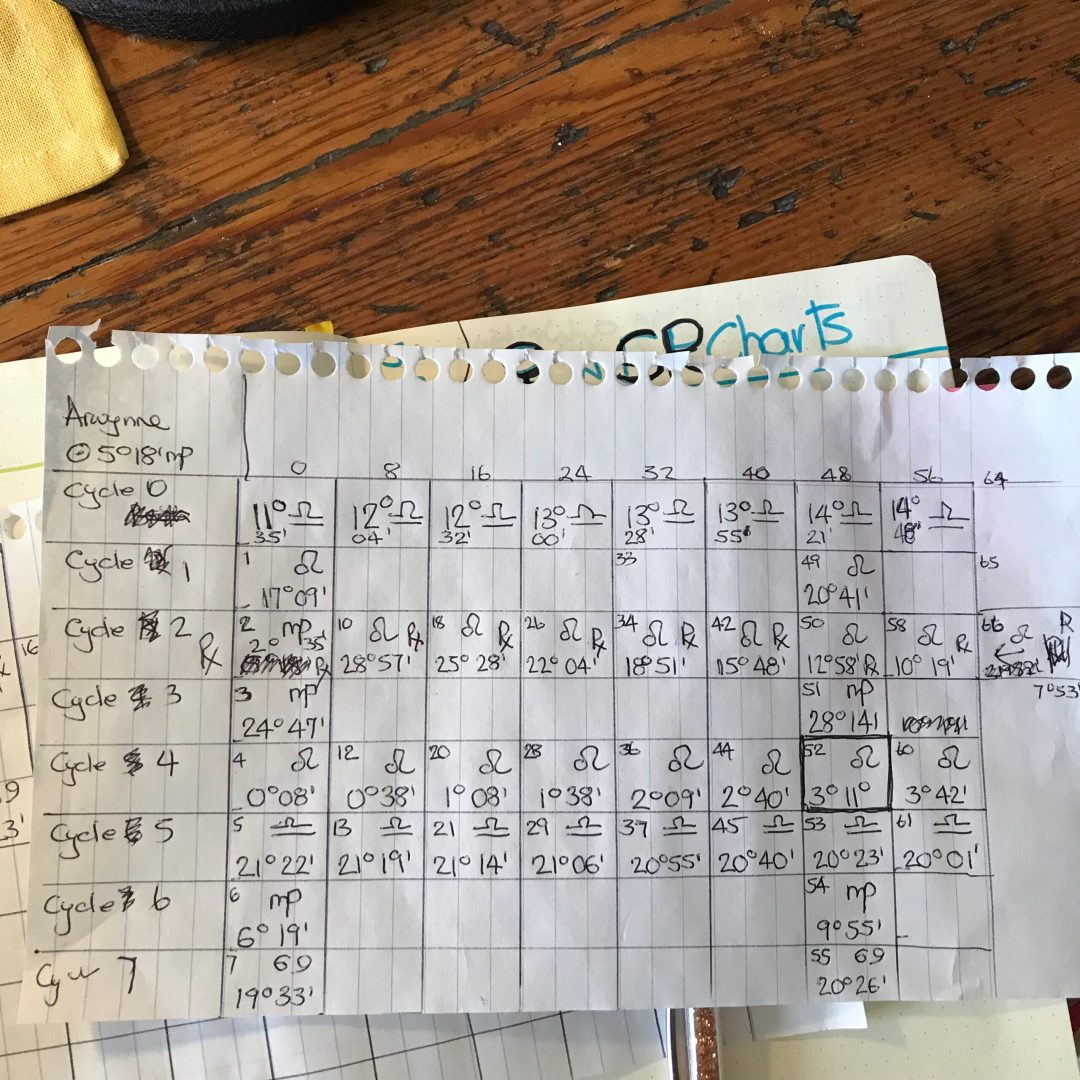
Of course, if you are truly looking into the Venus profile in your chart regarding love and money, you would cast the Venus return chart itself. This makes more sense. But what we are taking about are the 8 placements found in Venus’ position in subsequent 8 yearly solar return charts.
In a way it’s crazy that this occurs. That the Fibonacci 5-8 that shows up in Venus retrograde motion, is also reflected in the eight solar return starting positions for Venus. And really, it’s not the solar return that triggers this, but rather it is the precise movement of Venus.
Only the three planets, the Sun, the Moon and Venus have a repeating pattern in Solar Return charts. All the other planets can be absolutely anywhere in the chart. There is no pattern in the solar return charts for Mercury, Mars, Jupiter, Saturn, Uranus, Neptune and Pluto.
As I said before, as an astrologer I like to see patterns. I find the fact that we only have 8-cycles of Venus in Solar Return charts something interesting that can be followed through and therefore predicted.
As I said in the podcast, I urge all aspiring astrologers to find what interests them within astrology, which is of course our subject. Find the specific topic that interests you and do some research, dig deeper, explore more and become the expert in the tightest niche possible within astrology itself. Most of the astrology books on my shelf were written 2000 years ago or in the last century. We need these books to learn astrology, but just because things were done one way in the past doesn’t mean that there’s not something new to be discovered.
I like to reference the Davidson chart readings, which he only discovered in the 1960s, which is a brilliant technique that now every astrology is using. I think every astrologer has something to offer and if you do some research or explore your topic thoroughly you could very easily bring a whole new technique to astrology and to the astrology field in general.
And perhaps you’re already doing this. Perhaps you are already exploring one particular thing within astrology. It doesn’t have to be complete, and it doesn’t have to be finalized because that’s the nature of research. But if this sounds like you and you’ve got something that you’ve been looking into, I’d love to hear from you and I’d love to get you on my podcast.
If you would be interested, you can read more about being a good podcast guest here. And when you’re ready you can pitch your topic.
In your astrology journal and using your natal and no doubt multiple solar return charts please do the following:
In your astrology journal and using your natal and no doubt multiple solar return charts please do the following:

Here are some books which may interest you.

Here are a few more Venus related topics you may like.
⠀
Alison helps you uncover your individual creativity and lead a fulfilling life using your own astrology. She shares her wisdom from the heart with a touch of humor. She offers Consultations for everyone and Coaching for Aspiring Astrologers.
If you’d like to get in touch with Alison, you can reach out to her via email at starzology@gmail.com.
If you enjoyed this post, you may like some more astrology related articles from our blog.

Author: Alison Price - Published: January 2026 About Starzology Overarches Who Creates the Starzology Monthly Overarches? Each Starzology Monthly Overarch is thoughtfully written by me, Alison Price, a professional astrologer based in beautiful Vancouver, Canada....

Author: Alison Price - Updated: June 2026 🧡 Advanced Natal Astrology This article is part of my Advanced Natal Astrology series, where I explore deeper chart analysis for practicing and aspiring astrologers.Prenatal Eclipses Introduction Before Birth...
The page you requested could not be found. Try refining your search, or use the navigation above to locate the post.