
starzology banner

Support the Show

If you enjoy returning to the podcast each week, thank you for being part of our astrology community. Ongoing listener support helps keep the show thoughtful, independent and growing.

The Three Maya Calendars: A Beginner’s Guide for Astrology Students

The Three Maya Calendars: A Beginner’s Guide for Astrology Students

Author: Gil Pereira–   Published: May 2026

How the Tzolk’in, Haab’ and Long Count Work Together

A companion piece to Alison’s Mayan Long Count Calendar article.

If you have already read Alison’s piece on the Mayan Long Count Calendar, you know how the Maya measured deep historical time with remarkable precision. But the Long Count is only one part of the picture.

The Maya did not use a single calendar for everything. They used several interlocking systems simultaneously, each one measuring a different quality of time. The three most important are the Tzolk’in, the Haab’ and the Long Count.

Think of it like this: the Long Count is the system Alison already explained so well — the grand historical clock, the cosmic timestamp. This article zooms in on the other two, and shows how all three fit together.

The Three Maya Calendars: A Beginner’s Guide for Astrology Students

How the Tzolk’in, Haab’ and Long Count Work Together

Why Three Calendars?

As astrologers, we already understand this idea intuitively.

We do not use a single cycle to describe everything. The Moon moves through its phases in about 29 days. Saturn takes roughly 29 years to complete one orbit. Pluto works on a generational scale. Each cycle describes something different — a different quality, a different register of time.

The Maya thought the same way. Different cycles serve different purposes, and using them together gives a richer picture than any single system could offer alone.

Calendars Table

Here is a simple overview before we go deeper:

In shorthand:

  • The Tzolk’in gives the mood.
  • The Haab’ gives the season.
  • The Long Count gives the address.

The Tzolk’in: The 260-Day Sacred Cycle

The Tzolk’in is the most symbolically rich of the three calendars, and arguably the most immediately interesting for astrology students.

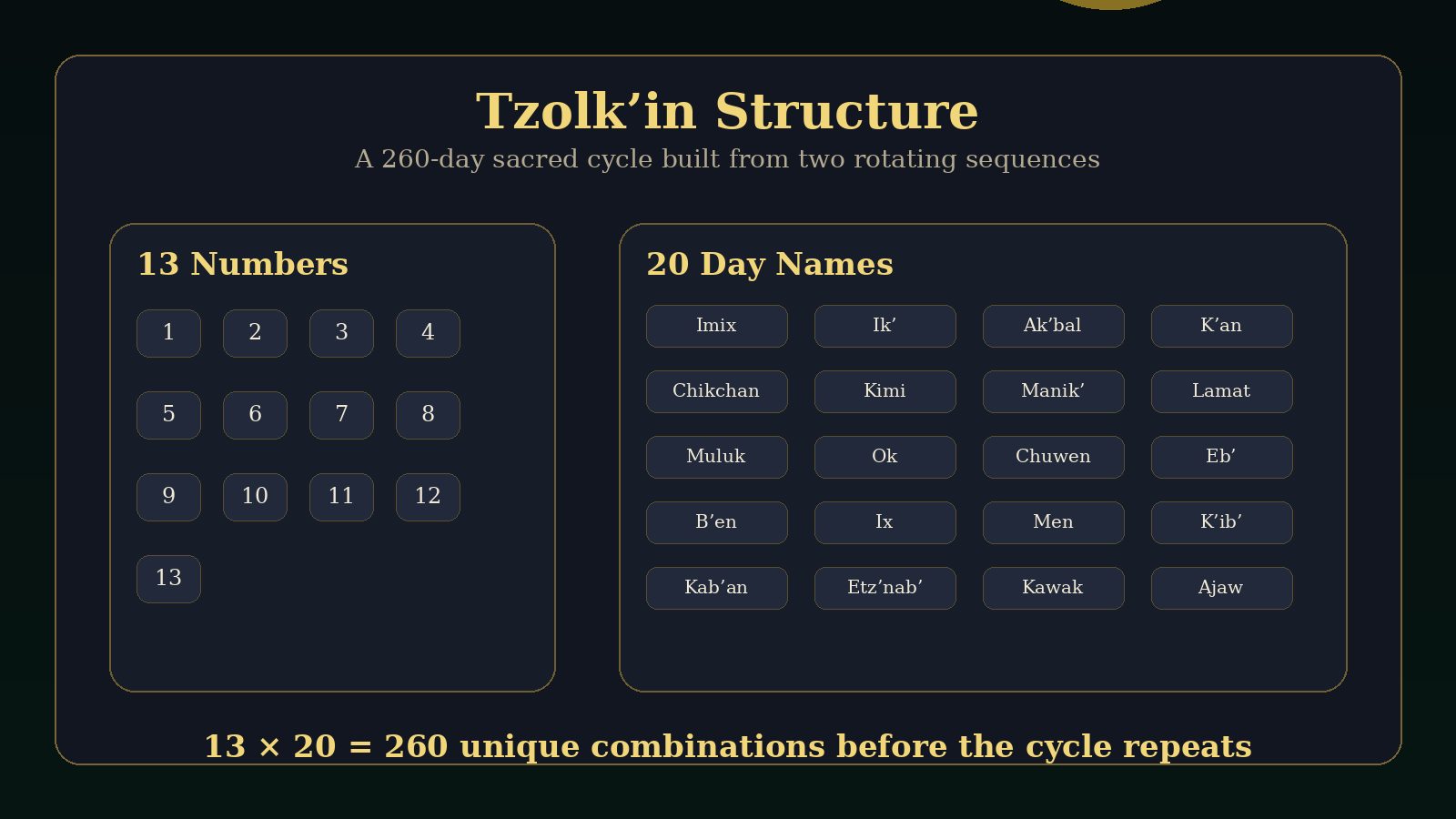
It works by combining two independent cycles:

  • 13 rotating numbers (1 through 13)
  • 20 named day signs (such as Imix, Ik’, Ak’b’al, K’an, and so on)

Because 13 and 20 share no common factor, they mesh together like interlocking gears, producing 260 unique day combinations before the pattern repeats. Each day in the Tzolk’in therefore has a specific number-and-sign pairing — a kind of energetic signature.
For an astrologer, this is immediately recognisable. The Tzolk’in does not just ask what date is it — it asks what kind of day is this?

That is very close to how we think about transits. A Mars transit does not make every day difficult in the same way. A Venus station does not automatically make every day easy. Each configuration describes a tone, a quality, a field of possibility. The Tzolk’in works in a comparable way.

One thing worth naming for context: historically, the Tzolk’in was used for religious ceremony, ritual timing and correlating events with mythological cycles — not primarily as a personal reflection tool in the way we might use a birth chart today. The more inward, psychological use is a modern adaptation. That does not make it less useful. It just means we are working in a different spirit than the original — which is true of many symbolic tools we have inherited and repurposed.

If you want to go deeper into the numerical layer of the Tzolk’in, the 13 Galactic Numbers are a natural next step — they carry their own symbolic weight within the cycle.

The Haab’: The 365-Day Solar Calendar

The Haab’ is the calendar that feels most familiar to modern readers, because it follows a solar year of 365 days.

It is structured as:

  • 18 named months of 20 days each (18 × 20 = 360 days)
  • Plus 5 extra days at the end of the year, called Wayeb’

That gives a total of 365 days.

For astrologers, the closest comparison is the Sun’s annual journey through the zodiac. When the Sun enters Aries, we associate it with beginnings and spring in the northern hemisphere. When it enters Capricorn — as Alison notes in her Long Count article, marking the winter solstice — we think of structure and maturity. The Haab’ situates human activity inside a similar solar rhythm.

A useful technical point: unlike the Gregorian calendar, the Haab’ had no leap year equivalent. The actual solar year is approximately 365.24 days, so the Haab’ slowly drifted out of alignment with the seasons over time. Scholars sometimes call it a “vague solar year” for this reason. The Maya were likely aware of this drift and tracked it separately — it did not make the calendar less useful, just different in purpose from a precise astronomical instrument.

The Wayeb’ — those final five days — were considered an unsettled, liminal period. Not quite the old year, not quite the new. Anyone who has felt the strange in-between quality of late December will recognise the feeling.

The Long Count: The Historical Clock

If you have read Alison’s article on the Long Count, you already have a solid grounding here. A quick recap for context:

The Long Count counts days in a linear sequence from a mythological starting point — equivalent to 11 August 3114 BCE in our calendar. It uses five nested units (kin, winal, tun, k’atun and b’aktun), and a complete date looks something like this: 13.0.0.0.0.

What the Long Count does that the other two calendars cannot is place a date in deep time — not just “what kind of day is this” or “where are we in the solar year”, but “where does this moment sit in the grand arc of history?”

For astrologers, this resonates with how we think about the slower outer planets. Pluto moving through Capricorn is not a personal transit for most people — it is a generational and civilisational process. The Long Count operates at that same scale.

As Alison explains in her Long Count article, the Maya themselves associated the rollover of a b’aktun (roughly every 394 years) with themes of change and transformation — not apocalypse, but transition. The same nuanced thinking we bring to a Saturn return or a Pluto square.

How the Three Systems Work Together

The real elegance of the Maya calendar is that these three systems were not separate tools used in isolation. They ran simultaneously, and a full Maya date included all three.

The Tzolk’in and Haab’ together form what is called the Calendar Round — a combined cycle of approximately 52 years. A specific Tzolk’in-Haab’ pairing (say, 4 Ahau 8 Kumku) only recurs every 52 years. To an individual living a normal lifespan, this was essentially a once-in-a-lifetime event — marking a significant transition point in community life.

The Long Count then anchors that Calendar Round date in the larger flow of historical time, giving it a unique, unrepeatable address in the cosmos.

So a complete Maya date carries three layers of meaning simultaneously:

For an astrology student, this is a wonderful structural reminder. A birth chart is not just the Sun sign. A transit is not just one planet in isolation. Time is always layered — and reading it well means holding multiple cycles at once.

A Practical Reflection Framework

You do not need to become a Maya calendar scholar to find these systems useful. As a starting point, try using the three calendars as a set of questions:

The Tzolk’in question: What is the symbolic quality of this moment? This parallels checking the Moon phase or a major transit before deciding how to direct your energy. What archetype is active? What tone does this period carry?

The Haab’ question: Where am I in the solar year? This connects naturally to solar ingress charts, equinoxes and solstices — the seasonal backbone that Alison works with throughout her forecasting content. Am I in a time of beginning, building, harvesting or releasing?

The Long Count question: What larger cycle is this part of? This is the perspective-shift question. Is what I am experiencing personal, or am I picking up something collective and historical? Am I overreacting to a temporary mood, or noticing a deeper pattern?

That last question, used consistently, can save you from a surprising number of hasty decisions — and at least a few unnecessary text messages during Mercury retrograde.

Why This Matters for Symbolic Astrology

The Maya calendar system teaches something that sits at the heart of astrological thinking: time is not flat.

Modern life tends to treat time as a logistical resource — appointments, deadlines, notifications. Astrology insists that time has texture, meaning and quality. Different moments carry different possibilities.

The three Maya calendars make exactly the same claim, through a completely different symbolic language. They show time as cyclical, sacred, practical and historical — and they show these dimensions operating simultaneously rather than competing for priority.

Studying them alongside Western astrology is not about blending the systems or claiming equivalence. It is about recognising a shared intuition across different traditions: that paying attention to time — its rhythms, its patterns, its recurring qualities — is a meaningful practice.

And as Alison puts it in her Long Count article: appreciating that the Mayan calendar is another example of how humans measure time places the whole system in perspective. Not as a novelty or a mystery, but as a serious symbolic tradition, built by people who looked at the same sky and asked the same questions we still ask today.

This article was written as a companion to Alison’s Mayan Long Count Calendar piece at Starzology. If you would like to explore the three calendars further, you can find a more detailed guide at ZodiacRoots, where I look at these systems as part of a wider comparative approach to symbolic traditions. Gil

Photo Credit

The images in this article were created originally for the ZodiacRoots three Maya calendars guide and are reproduced here with permission. © ZodiacRoots.com

About the Author

Gil Pereira writes about astrology, symbolic systems and comparative traditions at ZodiacRoots.com. His work explores how different cultures have used time, pattern and meaning to understand human experience — looking at Western astrology, Vedic, Egyptian, Celtic, Chinese and Mayan systems side by side rather than in isolation.

More Articles

If you enjoyed this post, you may like some more astrology related articles from our blog.


Druids and Celtic Astrology: History, Myth, and the Modern Tree Zodiac

Druids and Celtic Astrology: History, Myth, and the Modern Tree Zodiac

This article explores what people really mean by Celtic astrology, separating ancient Druidic traditions, tree symbolism, and modern interpretations. It gently untangles myth from history while showing how the modern tree zodiac still offers meaningful, nature-rooted insight, even if it is a thoughtful reconstruction rather than a preserved ancient system.

New Moon in Pisces

New Moon in Pisces

As an astrologer, it’s always interesting with a group of planets in one sign. This happens in February 2025 with five planets in Pisces.

2nd House Planets

2nd House Planets

Author: Alison Price   -   Updated: March 2025 Planets in the Second House Active Tenants The placement of planets in the second house will always influences your relationship with money, possessions, and personal values. Each planet brings its own energy, to shape...

Venus Retrograde 2025

Venus Retrograde 2025

Author: Alison Price   -   Published: March 2025 Venus Retrograde 2025 Mark your calendars, as the the love and money planet Venus is going retrograde and this is set to begin on March 2, 2025 and will continue until April 13, 2025, from Aries to 24° Pisces. This...

life-phase-reading-star
affiliates-green-star

Druids and Celtic Astrology: History, Myth, and the Modern Tree Zodiac

Druids and Celtic Astrology: History, Myth, and the Modern Tree Zodiac

Guest Post

This guest post by Gil of ZodiacRoots explores what people really mean by Celtic astrology, separating ancient Druidic traditions, tree symbolism, and modern interpretations. It gently untangles myth from history while showing how the modern tree zodiac still offers meaningful, nature-rooted insight, even if it is a thoughtful reconstruction rather than a preserved ancient system.

Author: Gil Pereira  –   Published: April 2026

Druids and Celtic Astrology: History, Myth, and the Modern Tree Zodiac

Introduction: What Do People Mean by “Celtic Astrology”?

“Celtic astrology” is one of those phrases that sounds ancient the moment you hear it. It evokes moonlit groves, sacred trees, Druids, and the feeling of an old wisdom preserved somewhere just beyond the edge of recorded history. It sounds, at first, as though it must refer to one coherent and ancient system.

But that is not quite the case.

In practice, “Celtic astrology” is a modern umbrella term. People use it to refer to several overlapping ideas: the Celtic Tree Zodiac, tree calendars, Ogham-inspired symbolic systems, seasonal nature-based correspondences, and modern neo-Druid spiritual interpretations. These systems may draw on genuinely old Celtic material, but they are not all parts of one clearly documented ancient astrological tradition.

That distinction matters. Not because modern symbolic systems are somehow less meaningful, but because they become easier to appreciate when we are clear about what they are and what they are not.

It also matters because the very language we use can be misleading. Terms like “astrology” and “horoscope” come with assumptions shaped by other traditions, especially the Hellenistic world. When people speak of “Celtic astrology” today, they are often applying a modern category to a much older cultural landscape that may not have organised sacred knowledge in quite that way.

This article is not an attempt to dismiss Celtic Tree Astrology, nor to mock the people who find meaning in it. Quite the opposite. The modern tree zodiac continues to attract readers because it speaks to something many people still long for: a relationship with nature, cyclical time, and symbolic life that feels rooted rather than abstract.

Still, if we want to approach the subject with care, it helps to separate three different layers that are often blended together: historical Druidism, Celtic symbolic material such as tree lore and Ogham, and modern reconstruction. Once those layers are distinguished, the subject becomes not less interesting, but more so.

Celtic-ogham

1. Three Layers That Should Not Be Confused

Part of the confusion around Celtic astrology comes from the fact that several different things are often spoken of as though they were one.

The first layer is historical Druidism. These were the Druids of the ancient Celtic world: the learned and religious elite described in classical sources, associated with sacred learning, ritual authority, law, teaching, and memory.

The second layer is Celtic symbolic material, including the cultural importance of trees, the later symbolic life of Ogham, and the broader imaginative world preserved in Irish and Celtic tradition. This layer is real, rich, and deeply suggestive, but it is not the same thing as an astrological system.

The third layer is modern reconstruction. This is where most versions of what people now call Celtic astrology belong. The Celtic Tree Zodiac, as usually encountered today, is largely a modern symbolic development shaped by literary imagination, revivalist spirituality, esoteric interpretation, and later synthesis.

None of these layers is unreal. All three matter. The difficulty begins only when they are collapsed into one story and presented as though the modern tree zodiac were a complete Druidic horoscope preserved intact from antiquity.

Once these layers are distinguished, the next question becomes clearer: what evidence actually survives for each of them, and where are the gaps?

2. What the Sources Do — and Do Not — Tell Us

This is one of the most important points in the whole discussion.

Most of what we know about the Druids comes from two broad kinds of source. The first is classical Greco-Roman writing, especially authors such as Julius Caesar and others who described Celtic societies from the outside. These sources are valuable, but they are also shaped by distance, politics, and the habits of Roman ethnography.

The second is medieval Irish material, written down much later in Christian contexts. These texts preserve important traces of older traditions, but they are not direct records of pre-Christian Druidic teaching. They come to us already filtered through time, redaction, literary reshaping, and a changed religious environment.

This does not make the sources useless. Far from it. But it does mean they have limits.

What they do not give us is a clearly attested ancient system called “Celtic astrology” in the modern sense. They do not describe a full tree zodiac, a standard set of tree birth signs, or an official Druidic horoscope in the form often presented today.

That absence is not a minor problem. It is the central reason the modern system should be understood as a reconstruction rather than as a direct survival.

3. Who Were the Historical Druids?

The Druids were not the charming woodland mystics of later romantic fantasy. In the ancient world, they appear as serious figures of intellectual and religious authority. Classical writers describe them as judges, philosophers, teachers, ritual specialists, and custodians of sacred knowledge. In Celtic societies, especially in Gaul and the British Isles, they seem to have held an important place in preserving law, memory, and cosmological order.

That already tells us something important. The Druids belonged to a culture capable of symbolic depth. They were not strangers to sacred time, ritual structure, or layered ways of reading the world. So it would be simplistic to imagine that the ancient Celts had no developed symbolic relationship with season, sky, or sacred order.

At the same time, that does not entitle us to place later horoscope-like systems directly in their hands. The Druids may very well have thought deeply about time, nature, and the sacred patterning of existence. But that is not the same as saying they used a birth-sign system based on thirteen trees.

The distinction matters because it allows us to respect the sophistication of ancient Celtic culture without forcing it into categories that may not belong to it.

4. The Coligny Calendar and the Qualitative Nature of Sacred Time

If we want firm historical evidence for Celtic sophistication in matters of time, the Coligny Calendar is one of the best places to look.

Discovered in 1897 near Lyon, in France, the Coligny Calendar is usually dated to the second century CE. It is a bronze lunisolar calendar and remains one of the most important archaeological witnesses to Celtic timekeeping ever found. Its structure shows that Celtic-speaking societies were capable of working with a carefully ordered system of months, lunar phases, and intercalary adjustments.

In other words, the ancient Celts did indeed possess a serious calendrical intelligence.

That matters because it challenges the lazy assumption that pre-modern cultures simply drifted through the seasons in a haze of vague nature mysticism. The Coligny Calendar points instead to a culture attentive to pattern, correction, recurrence, and sacred order.

It also suggests that time was not treated as neutral. Scholars have long noted distinctions in the calendar involving terms such as matisand anmatis or related contrasting designations, often understood as marking phases of differing quality, fullness, or favourability. The exact nuance is still debated, but the broader implication is clear enough: time was not merely counted, but qualified.

That is an important point. It suggests a worldview in which certain periods carried a different ritual or symbolic character. Time, in this sense, had texture.

And yet, even here, we should be careful. The Coligny Calendar does not contain a tree zodiac. It does not set out a sequence of tree birth signs, nor does it present an astrological system in the familiar natal sense.

So while it supports the broader claim that Celtic societies had an advanced and even sacralised relationship with time, it does not confirm the modern Celtic Tree Zodiac as such.

5. Ogham, Trees, and Later Symbolic Associations

Ogham is often brought into discussions of Celtic astrology, and understandably so. It is real, old, and visually arresting. It feels like the perfect bridge between language, nature, and sacred symbolism.

Historically, however, Ogham is a script. It appears mainly in early medieval Ireland and survives in inscriptions, particularly on stone. That is its primary identity: a writing system, not an astrological calendar.

Over time, later traditions associated a number of Ogham letters with tree names or woody plants. This helped create a strong imaginative link between language and the living world. Once that symbolic bridge existed, it became easier for later esoteric systems to build around it.

But this is exactly the point at which precision matters.

The idea that Ogham naturally unfolds into a complete tree-based zodiac or calendar is a much later interpretive development. It does not follow automatically from the historical existence of Ogham itself. The script provided fertile symbolic material, but the astrological architecture built upon it belongs largely to later reconstruction.

So the relationship is real, but it is not simple. Ogham helps explain how tree symbolism could gain structure and poetic force. It does not, by itself, prove the existence of an ancient Druidic tree horoscope.

The roots of the symbolism are old. The final arrangement is much newer.

6. Robert Graves and the Making of the Modern Tree Zodiac

If one name must be mentioned in any serious discussion of the modern Celtic Tree Zodiac, it is Robert Graves.

When Graves published The White Goddess in 1948, he did something powerful and controversial at once. He did not simply report historical evidence. He wove together poetry, comparative mythology, tree symbolism, lunar themes, Ogham associations, and literary intuition into a grand symbolic vision. That vision has shaped modern perceptions of Celtic tree lore ever since.

For many readers, the modern form of Celtic Tree Astrology comes not from archaeology or from a recovered ancient manual, but from the imaginative afterlife of Graves’s work.

This is where confusion often begins. Because Graves wrote so compellingly, it is easy to mistake symbolic brilliance for historical demonstration. But they are not the same thing.

Graves was not uncovering an intact ancient zodiac. He was composing a pattern from fragments, echoes, correspondences, and poetic insight. His work belongs as much to mythmaking as to scholarship.

That does not make it trivial. On the contrary, its endurance comes precisely from the depth of its imaginative power. But it does mean that The White Goddess should be read as a literary and mythic influence, not as proof that the modern tree zodiac existed in a stable ancient form.

This point is central. Without it, readers can easily slide from “this is meaningful” to “this must therefore be historically original.” Graves is one of the main reasons that slippage continues.

the-white-goddess-book-cover

7. Why There Is No Single Celtic Horoscope

Another clarification helps here: there is no single, universally agreed version of “Celtic astrology.”

Some systems focus on a tree zodiac built around date ranges. Others present a tree calendar with seasonal or lunar emphasis. Some draw inspiration from Ogham correspondences. Others use animal symbolism or simplified sign systems popularised online. Still others mix folklore, neo-pagan spirituality, seasonal archetypes, and personal growth language into looser modern frameworks.

These systems overlap, but they are not identical.

Part of the reason is that “Celtic astrology” is itself a modern label applied to a range of different symbolic constructions. But there is another reason as well. The very idea of a “horoscope” is not neutral. The familiar notion of a birth-based system that assigns traits, tendencies, or destiny through a codified set of signs belongs largely to the Hellenistic astrological tradition and its descendants.

Applying that model to Iron Age Celtic cultures may be suggestive, but it is not the same as recovering an indigenous Celtic equivalent.

So when we say there is no single Celtic horoscope, we are not merely saying that modern versions differ. We are also acknowledging that the genre itself may not map cleanly onto the culture to which it is being applied.

That helps explain why the modern field looks so varied. We are not uncovering one lost standard system. We are looking at a family of symbolic reconstructions shaped by different assumptions, influences, and needs.

8. Why the Modern System Still Speaks to People

If the historical case is uncertain, why does Celtic Tree Astrology continue to attract readers?

Part of the answer, I think, is that it restores something many modern people feel they have lost. It offers a language of identity rooted not only in the sky, but in the earth. It invites the imagination to move through grove, branch, bark, moon, season, and recurring time. It makes symbolic life feel textured again.

Many astrological systems are celestial by design. That is part of their beauty. But the Celtic layer, at least in its modern form, shifts attention toward a more terrestrial symbolism. Trees are not abstract symbols in the way planets sometimes become when handled too mechanically. They are living presences. They grow slowly. They stand in weather. They change with the year. They embody endurance, vulnerability, memory, and rootedness in ways people feel instinctively.

This may explain why the system remains meaningful even for readers who know the history is mixed. Its appeal is not only antiquarian. It is psychological, ecological, and imaginative.

It suggests that human identity is not only written in distant lights, but also shaped by the textures of the living world.

In a culture where time often feels flat, accelerated, and detached from place, that is no small thing.

9. Historical Value and Symbolic Value

One reason discussions of Celtic astrology become polarised is that people are often offered only two positions. Either the system is ancient and therefore meaningful, or it is modern and therefore false. That is a poor choice.

A better distinction is between historical value and symbolic value.

Historically, the evidence supports the existence of Druids, a rich Celtic symbolic world, the reality of Ogham, serious calendrical sophistication, and later traditions linking trees to language and lore. What it does not securely support is the popular modern tree zodiac as a complete, standard, ancient astrological system.

Symbolically, however, the picture is different. A modern system can still be meaningful if it helps people think more deeply, live more attentively, and enter into relationship with nature, season, and mythic pattern. Many traditions survive not by remaining frozen, but by being reimagined.

That does not excuse careless historical claims. But it does mean that reconstruction is not the same thing as emptiness.

The real question is not whether a system is ancient enough to count. The question is whether it is being used honestly, thoughtfully, and with a sense of proportion.

Seen in that light, the modern Celtic Tree Zodiac can be appreciated without either exaggerating its antiquity or dismissing its symbolic richness.

10. Myth with Integrity, History with Respect

Perhaps the healthiest way to approach Celtic astrology is to resist two opposite temptations.

The first is naïve literalism: the urge to present the modern tree zodiac as though it were a perfectly preserved ancient Druidic horoscope handed down intact through the centuries.

The second is cynical reductionism: the urge to say that because the system is modern in form, it therefore has no seriousness, no depth, and no value.

Neither position is satisfying.

A more balanced approach allows history to remain history and myth to remain myth, without forcing one to masquerade as the other. It accepts that the evidence is fragmentary, that the modern system is reconstructed, and that symbolic traditions can still matter deeply when they are held with honesty.

That kind of approach asks us to let go of the fantasy of perfect origins. But in return, it offers something better: a way of working with symbol that is neither gullible nor sterile.

Not credulity. Not debunking for sport. Just a little more clarity, and a little more reverence.

Conclusion

The phrase “Celtic astrology” carries more poetry than precision, and perhaps that is part of its appeal. It points toward a world in which trees, seasons, sacred time, and human character belong to one web of meaning. That world is not simply invented, but neither is it preserved in the neat and unbroken form often claimed for it.

The historical Druids were real. Ogham was real. Celtic calendrical sophistication was real. Tree symbolism was real. What is less certain is the idea of a single ancient Celtic zodiac corresponding exactly to the modern systems now circulating under that name.

Yet that uncertainty does not strip the modern tree zodiac of all value. It simply places it where it belongs: not as a fossil from antiquity, but as a modern symbolic tradition grown from older roots.

Seen that way, Celtic Tree Astrology becomes easier to respect. It need not be defended with exaggerated historical claims, nor dismissed because it emerged through reconstruction. It can be appreciated for what it actually is: a thoughtful, poetic attempt to reconnect identity with nature, season, and living symbol.

And perhaps that is enough. Perhaps it is even better than the illusion of certainty.

Author Bio: Gil Pereira

Gil Pereira is an astrology enthusiast and the founder of ZodiacRoots.com, a project that explores astrology through a broader symbolic lens by connecting Western astrology with ancestral and cross-cultural traditions. He is especially interested in the meeting point between myth, symbolism, and reflective astrological practice, and his work aims to make complex systems more accessible, thoughtful, and relevant for modern readers.

More Articles

If you enjoyed this post, you may like some more astrology related articles from our blog.


Druids and Celtic Astrology: History, Myth, and the Modern Tree Zodiac

Druids and Celtic Astrology: History, Myth, and the Modern Tree Zodiac

This article explores what people really mean by Celtic astrology, separating ancient Druidic traditions, tree symbolism, and modern interpretations. It gently untangles myth from history while showing how the modern tree zodiac still offers meaningful, nature-rooted insight, even if it is a thoughtful reconstruction rather than a preserved ancient system.

New Moon in Pisces

New Moon in Pisces

As an astrologer, it’s always interesting with a group of planets in one sign. This happens in February 2025 with five planets in Pisces.

2nd House Planets

2nd House Planets

Author: Alison Price   -   Updated: March 2025 Planets in the Second House Active Tenants The placement of planets in the second house will always influences your relationship with money, possessions, and personal values. Each planet brings its own energy, to shape...

Venus Retrograde 2025

Venus Retrograde 2025

Author: Alison Price   -   Published: March 2025 Venus Retrograde 2025 Mark your calendars, as the the love and money planet Venus is going retrograde and this is set to begin on March 2, 2025 and will continue until April 13, 2025, from Aries to 24° Pisces. This...

life-phase-reading-star
affiliates-green-star

Year of the Horse

Year of the Horse

Author: Alison Price   –   Updated: January 2026

💜 Wellbeing Astrology

This article is part of my Wellbeing category series, where I explore topics around living in tune with the natural solar cycles.

Year of the Horse

Celebrations Begin

The new year officially begins at the moment of the new Moon and celebrations often last for several days.

Natural Cycles

It is a beautiful system that keeps human life closely connected to natural cycles and the rhythm of the Moon.

Date

Tuesday, February 17th, 2026.

year-of-the-horse

Chart

Lunar New Year Chart

Note that the Year of the House begins at a solar eclipse to add some extra oomph to this year.

year-of-the-horse-chart

Horse Year Energy

Forward Momentum

The year of the Horse in 2026 brings energy that feels alive and forward moving. Horse years are about momentum enthusiasm and freedom.

Lean In

In 2026 this energy encourages people to find what makes them feel truly alive and to take confident steps toward it.

Movement

Start Your Crusade

For many this will be a year of movement. You may feel ready to chase goals you have carried for a long time.

Velocity

Plans that have felt stagnant can start to pick up speed as the Horse energy supports action and progress. This is a time to trust your instincts and follow where your passion leads.

Avoid Hesitation

It is not a year for waiting on the sidelines.

Self-expression

Be Yourself

The Horse is known for independence and self-expression. In 2026 people are invited to find their voice and stand in it.

Show Up

This energy supports courage in showing up as you are and claiming your path.

Loosen the Reins

If there is a part of your life where you have felt held back this year encourages you to loosen those restraints and move toward what feels meaningful.

Challenges

Impatience

At the same time the Horse can be impatient. There may be moments when progress feels too slow or when you want to sprint ahead before things are fully in place. The key is to balance eagerness with grounded planning and thoughtful pacing.

Prepare Yourself

This is still a year that rewards preparation discipline and clear intention even as it pushes you forward.

year-of-the-horse

Overarch

Power and Direction

Overall, the year of the Horse in 2026 offers a lively invitation to step into your power refine your direction and pursue your dreams with heart.

Boldness

It is a year to act boldly to live more freely and to trust that your energy can create real momentum in your world.


Resources

More articles on this topic.


Book Recommendations

Here are some Lunar and Chinese Zodiac books which may interest you.


Shop Year of the Horse Merch

Original Artworks

Enjoy a Year of the Horse mug featuring my original artwork. Each art piece is created by me and printed on everyday items you can actually use and enjoy. It is a simple way to rein in a little Year of the Horse energy and handmade art into your daily life. Alison


year-of-the-horse-redbubble

Author Bio

Alison Price: Professional Astrologer

Alison helps you uncover your individual creativity and lead a fulfilling life using your own astrology. She shares her wisdom from the heart with a touch of humor. She offers Consultations for everyone and Coaching for Aspiring Astrologers.

If you’d like to get in touch with Alison, you can reach out to her via email at starzology@gmail.com.

More Articles

If you enjoyed this post, you may like some more astrology related articles from our blog.


Druids and Celtic Astrology: History, Myth, and the Modern Tree Zodiac

Druids and Celtic Astrology: History, Myth, and the Modern Tree Zodiac

This article explores what people really mean by Celtic astrology, separating ancient Druidic traditions, tree symbolism, and modern interpretations. It gently untangles myth from history while showing how the modern tree zodiac still offers meaningful, nature-rooted insight, even if it is a thoughtful reconstruction rather than a preserved ancient system.

The Sun’s Aspects

The Sun’s Aspects

Author: Alison Price   -   Published: August 2025  ❤️ Basic Natal Astrology This article is part of my Basic Natal Astrology category and brings all the beginner components of interpreting a natal chart together. This includes signs, planets, houses,...

Saturn the Real Karma Chameleon

Saturn the Real Karma Chameleon

Guest Post This is a guest post by Maria Hayes and Astrologer and Tarot Reader from Trusted Astrology.Is Saturn the Real Karma Chameleon or Your Next Cosmic Life Coach? You know that feeling when life suddenly gets really serious? When the universe seems to be asking...

affiliates-green-star

Wheel of the Year Quack-Quack

Wheel of the Year Quack-Quack

Author: Alison Price   –   Published: July 2024

Wheel of the Year “Quack-Quack”

What is a Quack-Quack?

A “quack-quack” is a folded paper artwork (like origami) which you can use for many things. Typically, it is played to find yes/no answers or “he loves me, he loves me not” as a game.

Quack-quacks may have a better name, but when my kids were growing up, we called them quack-quacks because as you move them looks like little birds’ beaks opening and closing, thus the duck sound of quack-quack.

You can call them what you like and do let me know if you have a better name. In the meantime, I’ll continue to call them quack-quacks.

wot-quack-quack-ducklings

WOTY Quack-Quack

What You Do

Download

Download the Quack-Quack template below.

wheel-of-the-year-quack-quack

Print

Print out the full color page. You can make as many as you wish. You can also make it larger if you have bigger paper.

Cut Out

Carefully cut the full square diagram out. Try to keep the edges super sharp and square.

Folding Tips

As you make each fold be careful to keep the folds sharp. You can use a bone folder to help with this part.

When folding point into the middle, try to line it up exactly to keep the shape.

Fold

With the image facing down, fold the paper in half vertically then open.

Fold in half horizontally then open.

Still facing down, fold each corner into the centerfold crosshairs. This makes a smaller square.

Flip it over, colored side up.

Now fold each corner into the middle.

Gently open the four corners and place you thumbs and forefingers from both hands up into the little pockets.

Make it quack by opening and closing your fingers.

quack-quack-in-color-diagram

Wheel of the Year Festivals Summary

The Wheel of the Year is a modern pagan calendar that marks eight festivals, also known as Sabbats, celebrated by many Wiccans, Neo-Pagans, and other Earth-centered spiritual traditions. These festivals are tied to the cycles of the sun and the changing seasons.

Yule (Winter Solstice)

°Around December 21st, Yule marks the shortest day and longest night of the year. It celebrates the rebirth of the sun and the return of longer days. Traditions include lighting candles and fires, decorating with evergreens, and feasting.

Imbolc (Candlemas)

Around February 1st or 2nd, Imbolc signifies the midpoint between winter and spring. It is a time of purification and light, often associated with the goddess Brigid. People celebrate with candles, fire rituals, and early spring cleaning.

Ostara (Spring Equinox)

Around March 21st, Ostara represents balance, as day and night are of equal length. It celebrates the awakening of the earth and new beginnings. Traditions include planting seeds, decorating eggs, and celebrating fertility and growth.

Beltane (May Day)

Around May 1st, Beltane marks the peak of spring and the beginning of summer. It is a festival of fire and fertility, celebrating life and passion. Customs include dancing around the maypole, jumping over bonfires, and adorning with flowers.

  • More on BELTANE

Litha (Summer Solstice)

Around June 21st, Litha is the longest day of the year. It celebrates the power and strength of the sun at its zenith. Celebrations often involve bonfires, feasting, and connecting with nature.

Lammas (Lughnasadh)

Around August 1st, Lammas is the first harvest festival, marking the gathering of the first grains and fruits. It is a time of gratitude and abundance. Traditions include baking bread, holding feasts, and making corn dollies.

Mabon (Autumn Equinox)

Around September 21st, Mabon is another time of balance, with equal day and night. It is the second harvest festival, celebrating the fruits of the earth and giving thanks. Activities include feasting, sharing the harvest, and preparing for the colder months.

Samhain (Halloween)

Around October 31st, Samhain marks the end of the harvest and the beginning of winter. It is considered the pagan New Year and a time when the veil between the worlds is thin. Traditions include honoring ancestors, lighting candles, and sharing stories of the past.

These festivals offer a way to connect with nature, the changing seasons, and the cycles of life, encouraging mindfulness and gratitude throughout the year.


wheel-of-the-year-quack-quack

Pin this to read later

Author Bio

Alison Price: Professional Astrologer

Alison helps you uncover your individual creativity and lead a fulfilling life using your own astrology. She shares her wisdom from the heart with a touch of humor. She offers Consultations for everyone and Coaching for Aspiring Astrologers.

If you’d like to get in touch with Alison, you can reach out to her via email at starzology@gmail.com.

More Articles

If you enjoyed this post, you may like some more astrology related articles from our blog.


Druids and Celtic Astrology: History, Myth, and the Modern Tree Zodiac

Druids and Celtic Astrology: History, Myth, and the Modern Tree Zodiac

This article explores what people really mean by Celtic astrology, separating ancient Druidic traditions, tree symbolism, and modern interpretations. It gently untangles myth from history while showing how the modern tree zodiac still offers meaningful, nature-rooted insight, even if it is a thoughtful reconstruction rather than a preserved ancient system.

Mayan Long Count Calendar

Mayan Long Count Calendar

Author: Alison Price   -   Published: January 2013 Mayan Long Count Calendar Mayan Astrology Calendar End and Start The end of the Mayan calendar seemed to finish on December 21, 2012. Solstice Coincidence Winter Solstice The winter solstice most years falls on...

International Astrology Day

International Astrology Day

Author: Alison Price   –   Published: February 2024

International Astrology Day

Chart for 2024

Chart Details

This chart is set for the moment that the Sun enters Aries in 2024. 8:10pm, March 19th, 2024, in Vancouver. I’m using the Zero Aries house system so the chart is relevant for everywhere around the world.

Solar Cycle

Zero Aries

This day is a part of the solar cycle which is the path of the Sun every year. It is marked as the Sun crosses the celestial equator heading north which is when it enters Aries.

Equinox: Ostara

It is the equinox as well. In the Wheel of the Year this day is the festival of Ostara.


Chart Shape

Bowl Chart Shape

This chart is a loose bowl shape where all the planets are on one side of the chart. Frequently, the leading and trailing planets are in opposition. That the Moon is slightly out of the exact 180° shows that this is not technical a bowl, but for me it’s close enough.

  

Leading/Cutting Planet

The leading or cutting planet is Pluto in Aquarius. Pluto will rise ahead of all the other planets on this day and they will trail behind it as they rise over the horizon.


Trailing Planet

The trailing planet is the Moon in Leo.


Rim Opposition

The Moon is in opposition aspect to Pluto. This creates what is called a rim opposition. The idea is that they for the rim of the bowl.


international-astrology-day-chart-2024

Conjunctions

Sun Conjoined Neptune

The Sun is conjoined Neptune which is in dignity in Pisces. Here Neptune is at the tail end of Pisces but still strong in rulership. This is a disassociate aspects as the Sun is in the active fire sign of Aries and Neptune is in the passive water sign of Pisces.


Venus Conjoined Saturn

Venus is conjoined Saturn in Pisces. Venus is also parallel Saturn so that makes is a powerful “double whammy” conjunction and one not to be ignored.


More on Aspects of Declination.

Jupiter Conjoined Uranus

Jupiter is conjoined Uranus in Taurus. Jupiter is applying to Uranus and this means that the aspects is not yet exact but it is going to be exact later in the year as Jupiter moves towards Uranus.


Sun Complex

Ingress Chart

In an ingress chart, like this one, the Sun is the main player and its complex of sign, house, position, rulership and aspects is crucial to understanding the chart. An ingress chart is a chart set for the exact moment a planet enters a new sign or house. Typically, you look at solar ingresses for global interpretations. However, all planetary ingresses can be valuable to determine the energy shifts and expression of the period.
Sun Sign

The Sun is in Aries.

Sun Rules

The Sun disposes the Moon in Leo.

Sun Aspects

Neutral Aspects

The Sun is conjoined Neptune which is in dignity in Pisces.

Soft Aspects

The Sun is trine the Moon in Leo in the First Quarter phase. The Sun is sextile Pluto in Aquarius.

Major Aspect Pattern: Stellium

Stellium Planets

A stellium forms when three or more planets are within 8° of each other. The three planets in this chart’s stellium are Mercury, Chiron and Eris all in Aries. As the ruler of Aries the planet Mars disposes this stellium.

Major Aspect Pattern: Quintile Pointer

Quintile Pointer

There is a major aspect pattern of a fat quintile pointer with the three planets Moon, Venus and Uranus.

Quintile pointers only contain aspects of the fifth harmonic (when you divide the chart by 5). There are two aspects which are the quintile at 72° and the biquintile at 144°. Quintile pointers can be fat or thin it depends. The energy from the base planets (in this case the Moon and Venus) will flow towards the point or the focal planet Uranus and will be expressed out into the world at 20° Taurus. If you have planets or points at this position it will affect you more.

Focal Planet

Uranus in Taurus is the focal planet. Note that Uranus is disposed by Venus the ruler of Taurus. I would also consider that Venus is conjoined Saturn, and that Uranus is conjoined Jupiter when interpreting this quintile pointer.

 

Author Bio

Alison Price: Professional Astrologer

Alison helps you uncover your individual creativity and lead a fulfilling life using your own astrology. She shares her wisdom from the heart with a touch of humor. She offers Consultations for everyone and Coaching for Aspiring Astrologers.

If you’d like to get in touch with Alison, you can reach out to her via email at starzology@gmail.com.

More Articles

If you enjoyed this post, you may like some more astrology related articles from our blog.


Druids and Celtic Astrology: History, Myth, and the Modern Tree Zodiac

Druids and Celtic Astrology: History, Myth, and the Modern Tree Zodiac

This article explores what people really mean by Celtic astrology, separating ancient Druidic traditions, tree symbolism, and modern interpretations. It gently untangles myth from history while showing how the modern tree zodiac still offers meaningful, nature-rooted insight, even if it is a thoughtful reconstruction rather than a preserved ancient system.

Mabon

Mabon

Mabon Quarter Day

Equinox

Mabon, also known as the Autumn Equinox, is one of the Quarter Days celebrated in various cultures and traditions.

It falls around September 21st to 23rd in the Northern Hemisphere, marking the halfway point between the Summer Solstice and the Winter Solstice.

Astrologically Mabon is when the Sun enters Libra at zero degrees.

During Mabon, day and night are nearly equal in length, symbolizing a moment of balance and harmony in nature.

It is a time to give thanks for the bountiful harvest and to prepare for the cooler months ahead and express gratitude for the abundance of the Earth.

Many people commemorate Mabon by having in feasts, sharing meals with loved ones, and giving thanks for the gifts of the season.

Quarter Day

This Quarter Day holds spiritual significance, as it represents a time of reflection, introspection, and preparation for the colder months ahead.

It encourages us to pause and take stock of our lives, giving thanks for the blessings we’ve received and contemplating the lessons learned throughout the year.

Symbolically, Mabon is associated with the theme of letting go, similar to the falling leaves of autumn.

It prompts us to release what no longer serves us and make space for new growth and opportunities in the future.

Wheel of the Year

As the Wheel of The Year turns, Mabon invites us to appreciate the changing seasons, embrace the cycles of life, and find harmony within ourselves and the world around us.

Whether through ceremonies, rituals, or simple moments of gratitude, Mabon provides a chance to connect with nature’s rhythms and celebrate the beauty of the autumnal season.

Get Your Astro Artworks

All the original Astro Artworks on this page are digitally created by Alison.

Her interest in the Solar Cycles and how the annual seasonal flow impacts us all is the inspiration for this piece.

If you love this image of Mabon and you want to get some greeting cards like this, we invite you to visit our Art Shop.

Every purchase helps to support this blog.

Thank you.

Mabon Colors

Autumn Colors

Traditional colors associated with Mabon reflect the vibrant and earthy hues of the autumn season.

As a harvest festival, Mabon celebrates the bountiful gifts of nature and the changing colors of the landscape.

The colors that are commonly associated with this festival are below.

Orange

Orange is one of the most prominent colors of Mabon, representing the warm and inviting tones of autumn foliage.

It symbolizes the changing leaves and the abundance of the harvest season.

Orange is also associated with the setting sun, signifying the waning light and the approaching darkness of winter.

Brown

Brown represents the rich, fertile soil that nurtures the crops and allows them to grow and flourish.

It symbolizes the Earth’s abundance and the importance of grounding and stability during the seasonal transition.

Maroon

Deep red hues, reminiscent of ripe apples and other fall fruits, are often associated with Mabon.

This color represents the life force and energy within the fruits of the harvest.

Red is also linked to the changing color of the leaves as they prepare to fall from the trees.

Yellow

Yellow is the color of the golden harvest, symbolizing the ripened grains and crops ready for harvest.

It represents prosperity, abundance, and the rewards of hard work and dedication.

Forest Green

Dark green is associated with the evergreen plants that remain vibrant and strong even as the landscape changes around them.

It represents resilience and the continuity of life.

Deep Purple

Deep purple hues are reminiscent of grapes and the wine-making process, which is often associated with the harvest season.

Purple also represents transformation and the changing of the seasons.

Gold

Gold is a color that signifies the rewards of a successful harvest and the preciousness of nature’s gifts.

It symbolizes the value and abundance of the Earth’s offerings.

Decoration

These traditional colors associated with Mabon are often used in decorations, altars, candles, and other festive elements during the celebration.

By incorporating these colors, people honor the beauty of the autumn season, express gratitude for the harvest’s bounty, and create a warm and welcoming atmosphere for gatherings and rituals during this special time of the year.

Mabon Traditional Gatherings

Mabon, also known as the autumn equinox, is a time of balance between day and night, marking the transition from the warmer days of summer to the cooler days of fall. It's a significant point on the Wheel of the Year and is often celebrated by various pagan and neopagan traditions. Traditional gatherings during Mabon focus on themes of gratitude, reflection, and the harvest season.

Here's a glimpse into Mabon traditional gatherings:

  • Mabon is a time to celebrate the second harvest of the year. Traditional gatherings often feature feasts that highlight the bounty of the season. Participants may share dishes made from the abundance of fruits, vegetables, and grains harvested during the fall.

  • Many Mabon celebrations take place outdoors to connect with nature's changing energies. Picnics, potlucks, and gatherings in parks or gardens provide an opportunity to enjoy the crisp air and the beauty of the changing foliage.

  • Rituals during Mabon often focus on balance and gratitude. Participants may create altars adorned with symbols of the season, such as colorful leaves, gourds, and apples. Candles may be lit to represent the balance between light and darkness.

  • Apples are a quintessential fruit of the fall season. Traditional gatherings may include apple picking excursions to orchards, where participants can gather apples for use in rituals, crafts, and delicious treats.

  • Craft activities that reflect the season's themes are often part of Mabon gatherings. Creating wreaths, decorating pumpkins, making corn husk dolls, and crafting gratitude journals are ways to connect with the spirit of Mabon creatively.

  • Drumming circles can be a lively and vibrant way to celebrate Mabon. The rhythmic beat of drums symbolizes the heartbeat of the Earth and can help participants feel more connected to nature and the changing seasons.

  • Expressing gratitude for the harvest and the blessings of the year is a central aspect of Mabon gatherings. Rituals and practices that focus on gratitude, such as sharing stories of thankfulness or creating gratitude lists, help participants center their celebrations around appreciation.

  • Traditional dances and music can add a festive and joyful atmosphere to Mabon gatherings. Folk dances, singing, and playing musical instruments bring a sense of community and celebration.

  • Taking a leisurely walk in nature during Mabon can be a simple yet profound way to connect with the changing landscape and the energies of the season. Participants may gather fallen leaves, acorns, and other natural elements for use in crafts or rituals.

  • Mabon is a time for coming together as a community to celebrate the harvest and the changing of the seasons. Community potlucks, gatherings, and circles allow participants to share their experiences, stories, and reflections.

Mabon traditional gatherings revolve around themes of gratitude, reflection, and the harvest season.

They offer participants the opportunity to connect with nature, each other, and the spiritual significance of the equinox.

Whether you're using astrology as a tool for inspiration or simply seeking to live your best life, Mabon gatherings provide a space for embracing the balance of the season and expressing appreciation for the Earth's abundance.

Mabon Sacred Spaces

Creating a sacred space for Mabon, also known as the autumn equinox, allows you to connect with the energies of the season and engage in meaningful rituals and reflections.

A Mabon sacred space is a place where you can honor the balance between light and darkness, express gratitude for the harvest, and embrace the changing energies of fall.

Here's how you can set up a Mabon sacred space:

  • Choose a quiet and peaceful location where you can set up your sacred space. This could be indoors or outdoors, depending on your preferences and the weather.

  • Create an altar as the centerpiece of your sacred space. Use a table, shelf, or any flat surface to arrange your altar items. Cover it with a cloth in fall colors like orange, deep red, or brown.

  • Decorate your altar with items that represent the themes of Mabon. This can include colorful leaves, acorns, pinecones, pumpkins, gourds, apples, and autumn flowers like marigolds and chrysanthemums.

  • Place candles on your altar to symbolize the balance between light and darkness. You can use two candles—one white or yellow to represent the sun and one black or dark blue to represent the night.

  • Incorporate crystals that resonate with the energies of fall and balance, such as citrine, carnelian, amethyst, and clear quartz. Arrange them on your altar or use them as decorations.

  • Burn incense or use essential oils with fall scents like cinnamon, clove, and nutmeg. The aroma can help you create a sensory connection to the season.

  • Add seasonal fruits like apples, pears, and grapes to your altar. You can also include grains like wheat, corn, or barley as offerings to represent the harvest.

  • If you have specific tools you use in rituals, such as a cauldron, athame (ritual knife), or wand, place them on your altar as well.

  • If you work with specific deities, ancestors, or spirit guides, you can include representations or images of them on your altar.

  • Place a small piece of paper or parchment on your altar where you can write down your intentions for the season. This could include things you're grateful for, what you're releasing, or what you're inviting into your life.

  • Create a comfortable space near your altar where you can sit and meditate. Use this space for reflection, gratitude practices, and setting intentions for the coming season.

  • As a way of expressing gratitude, you can offer some of the fruits, nuts, or grains from your altar to the Earth, either by placing them outside or by incorporating them into your fall cooking.


By setting up a Mabon sacred space, you create a dedicated area where you can honor the energies of the autumn equinox, reflect on the harvest season, and engage in rituals that align with your spiritual practices.

This space serves as a visual representation of your connection to the changing rhythms of nature and the spiritual significance of Mabon.


Mabon Poem: Harvest's Balance

Here's a poem I wrote that captures the spirit of Mabon, the autumn equinox, and its themes of balance, gratitude, and the changing of the seasons:

Harvest's Balance


As summer's warmth begins to wane,

The equinox arrives again,

A moment's pause in time and space,

When light and dark find their embrace.


The scales of nature gently sway,

As night and day hold equal sway,

A harmony of sun and moon,

In Mabon's gentle, whispered tune.


The leaves, ablaze in colors bright,

Bid summer's fond farewell tonight,

And in their fall, a sacred dance,

Of letting go with elegance.


The fruits of labor, rich and sweet,

Now gathered in for all to eat,

A feast of gratitude we share,

For earth's provision, tender care.


With every bite, a whispered prayer,

For cycles, gifts beyond compare,

The turning wheel, a constant guide,

As seasons shift and worlds collide.


In this moment of perfect blend,

We find the balance, time to spend,

To honor Earth's abundant store,

And give thanks for the evermore.


As autumn's cloak wraps earth in gold,

The stories of the year are told,

In Mabon's light, we find our way,

A dance of night and equal day.


This poem reflects the themes of balance, gratitude, and the harvest season that Mabon embodies.

It can be recited during rituals, gatherings, or moments of reflection to honor the energy of the autumn equinox.


Mabon Folk Dance

If you're looking for a folk dance to embrace the spirit of Mabon and connect with nature's rhythms, the "Harvest Reel" might be a perfect choice.

The Harvest Reel

The Harvest Reel is a lively and joyful folk dance that embodies the essence of the season.

It can be performed outdoors, surrounded by the beauty of nature, or even indoors to bring the spirit of the outdoors in.

This dance is all about celebrating the abundance of the harvest and the changing of the seasons.

To perform the Harvest Reel, you can follow these simple steps:

  • Gathering in a Circle: Form a circle with friends and fellow dancers. Imagine you're creating a circle that represents the cyclical nature of the seasons.


  • Harvesting Movements: Begin by swaying gently from side to side, mimicking the movement of stalks swaying in the breeze. Imagine you're gathering the ripe fruits and grains from the fields.


  • Sun and Moon Gestures: As you dance, incorporate movements that symbolize the sun and the moon. Lift your arms high above your head to represent the sun's energy, and then lower them to your sides to symbolize the gentle light of the moon.


  • Partner Swaps: If you're dancing in a group, consider a part of the dance where partners swap. This reflects the changing partnerships in nature as different plants and animals interact during the seasons.


  • Harvest Basket: Hold your hands together in front of you as if holding a basket. With each step, imagine adding a piece of harvest bounty to your basket.


  • Seasonal Changes: As the dance progresses, introduce changes in your movements to reflect the transition from the warm days of summer to the cooler embrace of autumn. You can incorporate skipping, hopping, and gentle spinning to embody the changing weather.


  • Crescent and Full Moon Steps: Create steps that mimic the shape of the crescent moon and the full moon. These steps can add a touch of whimsy and symbolism to your dance.


  • Celebratory Claps: Towards the end of the dance, incorporate celebratory claps and cheers to represent the joy of a successful harvest and the gratitude for nature's gifts.


The Dance Experience

Remember, the Harvest Reel isn't about perfect choreography.

It's about embracing the energy of the season, connecting with your fellow dancers, and expressing your gratitude for the bounties of the earth.

Feel free to add your own twists and movements inspired by the natural world around you.

By dancing the Harvest Reel, you'll be living in tune with the solar cycles, celebrating the Wheel of the Year, and embodying the essence of Mabon.

Whether you're dancing in a meadow, a park, or your own living room, this dance will help you connect with nature, celebrate the harvest, and live your best life in harmony with the changing seasons.

Author Bio

Alison Price: Astrology Coach

Alison wants to help you uncover your individual creativity and lead a fulfilling life using your own astrology. She shares her wisdom from the heart with a touch of humor.

Learn more about Alison's journey.

If you'd like to get in touch with Alison, you can reach out to her via email at starzology@gmail.com.

More Articles

If you enjoyed this post, you may like some more astrology related articles from our blog.


Solstice Turning Points

Solstice Turning Points

Gain insights on the symbolism of the Solar cycles, and focus on the solstices. Let’s explore the significance behind these celestial events and delve into the meaning they hold.

Quincunxes

Quincunxes

In astrology, the quincunx aspect is 150 degrees with an orb of 2 degrees. It is the aspect of adjustment, awkwardness and mild irritation. Signs quincunx each other are five signs apart.