
Author: Gil Pereira– Published: May 2026
How the Tzolk’in, Haab’ and Long Count Work Together
A companion piece to Alison’s Mayan Long Count Calendar article.
If you have already read Alison’s piece on the Mayan Long Count Calendar, you know how the Maya measured deep historical time with remarkable precision. But the Long Count is only one part of the picture.
The Maya did not use a single calendar for everything. They used several interlocking systems simultaneously, each one measuring a different quality of time. The three most important are the Tzolk’in, the Haab’ and the Long Count.
Think of it like this: the Long Count is the system Alison already explained so well — the grand historical clock, the cosmic timestamp. This article zooms in on the other two, and shows how all three fit together.
The Three Maya Calendars: A Beginner’s Guide for Astrology Students
How the Tzolk’in, Haab’ and Long Count Work Together
Why Three Calendars?
As astrologers, we already understand this idea intuitively.
We do not use a single cycle to describe everything. The Moon moves through its phases in about 29 days. Saturn takes roughly 29 years to complete one orbit. Pluto works on a generational scale. Each cycle describes something different — a different quality, a different register of time.
The Maya thought the same way. Different cycles serve different purposes, and using them together gives a richer picture than any single system could offer alone.
Calendars Table
Here is a simple overview before we go deeper:

In shorthand:
- The Tzolk’in gives the mood.
- The Haab’ gives the season.
- The Long Count gives the address.
The Tzolk’in: The 260-Day Sacred Cycle
The Tzolk’in is the most symbolically rich of the three calendars, and arguably the most immediately interesting for astrology students.
It works by combining two independent cycles:
- 13 rotating numbers (1 through 13)
- 20 named day signs (such as Imix, Ik’, Ak’b’al, K’an, and so on)
Because 13 and 20 share no common factor, they mesh together like interlocking gears, producing 260 unique day combinations before the pattern repeats. Each day in the Tzolk’in therefore has a specific number-and-sign pairing — a kind of energetic signature.
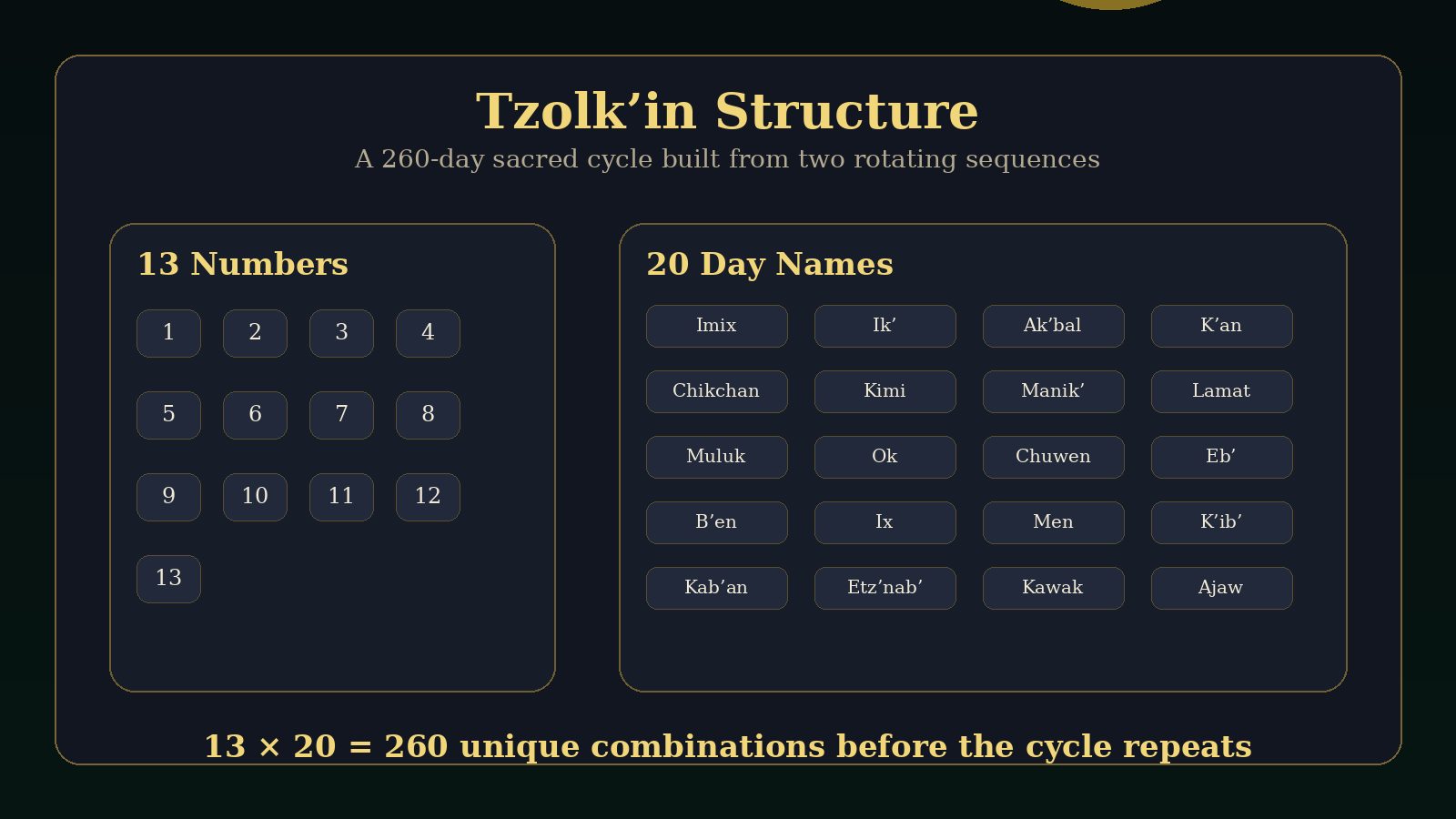
For an astrologer, this is immediately recognisable. The Tzolk’in does not just ask what date is it — it asks what kind of day is this?
That is very close to how we think about transits. A Mars transit does not make every day difficult in the same way. A Venus station does not automatically make every day easy. Each configuration describes a tone, a quality, a field of possibility. The Tzolk’in works in a comparable way.
One thing worth naming for context: historically, the Tzolk’in was used for religious ceremony, ritual timing and correlating events with mythological cycles — not primarily as a personal reflection tool in the way we might use a birth chart today. The more inward, psychological use is a modern adaptation. That does not make it less useful. It just means we are working in a different spirit than the original — which is true of many symbolic tools we have inherited and repurposed.
If you want to go deeper into the numerical layer of the Tzolk’in, the 13 Galactic Numbers are a natural next step — they carry their own symbolic weight within the cycle.
The Haab’: The 365-Day Solar Calendar
The Haab’ is the calendar that feels most familiar to modern readers, because it follows a solar year of 365 days.
It is structured as:
- 18 named months of 20 days each (18 × 20 = 360 days)
- Plus 5 extra days at the end of the year, called Wayeb’
That gives a total of 365 days.
For astrologers, the closest comparison is the Sun’s annual journey through the zodiac. When the Sun enters Aries, we associate it with beginnings and spring in the northern hemisphere. When it enters Capricorn — as Alison notes in her Long Count article, marking the winter solstice — we think of structure and maturity. The Haab’ situates human activity inside a similar solar rhythm.
A useful technical point: unlike the Gregorian calendar, the Haab’ had no leap year equivalent. The actual solar year is approximately 365.24 days, so the Haab’ slowly drifted out of alignment with the seasons over time. Scholars sometimes call it a “vague solar year” for this reason. The Maya were likely aware of this drift and tracked it separately — it did not make the calendar less useful, just different in purpose from a precise astronomical instrument.
The Wayeb’ — those final five days — were considered an unsettled, liminal period. Not quite the old year, not quite the new. Anyone who has felt the strange in-between quality of late December will recognise the feeling.
The Long Count: The Historical Clock
If you have read Alison’s article on the Long Count, you already have a solid grounding here. A quick recap for context:
The Long Count counts days in a linear sequence from a mythological starting point — equivalent to 11 August 3114 BCE in our calendar. It uses five nested units (kin, winal, tun, k’atun and b’aktun), and a complete date looks something like this: 13.0.0.0.0.
What the Long Count does that the other two calendars cannot is place a date in deep time — not just “what kind of day is this” or “where are we in the solar year”, but “where does this moment sit in the grand arc of history?”
For astrologers, this resonates with how we think about the slower outer planets. Pluto moving through Capricorn is not a personal transit for most people — it is a generational and civilisational process. The Long Count operates at that same scale.
As Alison explains in her Long Count article, the Maya themselves associated the rollover of a b’aktun (roughly every 394 years) with themes of change and transformation — not apocalypse, but transition. The same nuanced thinking we bring to a Saturn return or a Pluto square.
How the Three Systems Work Together
The real elegance of the Maya calendar is that these three systems were not separate tools used in isolation. They ran simultaneously, and a full Maya date included all three.
The Tzolk’in and Haab’ together form what is called the Calendar Round — a combined cycle of approximately 52 years. A specific Tzolk’in-Haab’ pairing (say, 4 Ahau 8 Kumku) only recurs every 52 years. To an individual living a normal lifespan, this was essentially a once-in-a-lifetime event — marking a significant transition point in community life.
The Long Count then anchors that Calendar Round date in the larger flow of historical time, giving it a unique, unrepeatable address in the cosmos.
So a complete Maya date carries three layers of meaning simultaneously:

For an astrology student, this is a wonderful structural reminder. A birth chart is not just the Sun sign. A transit is not just one planet in isolation. Time is always layered — and reading it well means holding multiple cycles at once.
A Practical Reflection Framework
You do not need to become a Maya calendar scholar to find these systems useful. As a starting point, try using the three calendars as a set of questions:
The Tzolk’in question: What is the symbolic quality of this moment? This parallels checking the Moon phase or a major transit before deciding how to direct your energy. What archetype is active? What tone does this period carry?
The Haab’ question: Where am I in the solar year? This connects naturally to solar ingress charts, equinoxes and solstices — the seasonal backbone that Alison works with throughout her forecasting content. Am I in a time of beginning, building, harvesting or releasing?
The Long Count question: What larger cycle is this part of? This is the perspective-shift question. Is what I am experiencing personal, or am I picking up something collective and historical? Am I overreacting to a temporary mood, or noticing a deeper pattern?
That last question, used consistently, can save you from a surprising number of hasty decisions — and at least a few unnecessary text messages during Mercury retrograde.
Why This Matters for Symbolic Astrology
The Maya calendar system teaches something that sits at the heart of astrological thinking: time is not flat.
Modern life tends to treat time as a logistical resource — appointments, deadlines, notifications. Astrology insists that time has texture, meaning and quality. Different moments carry different possibilities.
The three Maya calendars make exactly the same claim, through a completely different symbolic language. They show time as cyclical, sacred, practical and historical — and they show these dimensions operating simultaneously rather than competing for priority.
Studying them alongside Western astrology is not about blending the systems or claiming equivalence. It is about recognising a shared intuition across different traditions: that paying attention to time — its rhythms, its patterns, its recurring qualities — is a meaningful practice.
And as Alison puts it in her Long Count article: appreciating that the Mayan calendar is another example of how humans measure time places the whole system in perspective. Not as a novelty or a mystery, but as a serious symbolic tradition, built by people who looked at the same sky and asked the same questions we still ask today.
This article was written as a companion to Alison’s Mayan Long Count Calendar piece at Starzology. If you would like to explore the three calendars further, you can find a more detailed guide at ZodiacRoots, where I look at these systems as part of a wider comparative approach to symbolic traditions. Gil
Photo Credit
The images in this article were created originally for the ZodiacRoots three Maya calendars guide and are reproduced here with permission. © ZodiacRoots.com

About the Author
Gil Pereira writes about astrology, symbolic systems and comparative traditions at ZodiacRoots.com. His work explores how different cultures have used time, pattern and meaning to understand human experience — looking at Western astrology, Vedic, Egyptian, Celtic, Chinese and Mayan systems side by side rather than in isolation.
More Articles
If you enjoyed this post, you may like some more astrology related articles from our blog.

Yule
Discover a little about Yule and how the Suns’s position in Capricorn triggers this special quarter day in the year.

Astro Journal Flip Through
See how I created my Astro Journal to help align myself with the seasons and see a flip through of my month.

Lammas
Learn a little about the pagan festival of Lammas which occurs as the Sun reaches 15 degrees of the fixed sign Leo.

Saturn Conjoined Neptune
In astrology, a new synodic cycle begins as two planets conjoin. This almost happens for SATURN and NEPTUNE in 2025 and will be exact in 2026.

9th House
In astrology, the 9th HOUSE suggests your general knowledge, religion, travel, philosophy and what you publish.

5th House
In astrology, the 5th HOUSE suggests your creative side. It rules recreation and procreation as well as gambling and the stock exchange.